Jacksonville’s Fire Station No. 3 reborn again

January 2015 First Coast Magazine

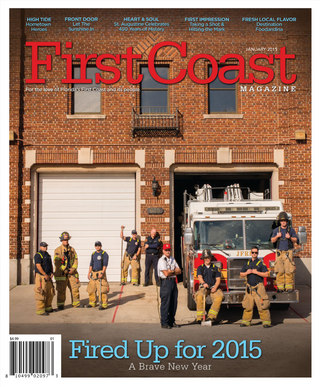
My most recently published writing may be found in the January 2015 issue of First Coast Magazine. This relatively new magazine is beautifully designed and always features interesting information about the northeast Florida community. I’m so excited to have been asked to write for the publication.

You can also read the story here:

Like the fabled phoenix in Egyptian mythology that was consumed by fire, only later to rise renewed from its ashes, Fire Station No.3 has been reborn – and more than once. It originally opened in 1886 on East Bay Street in downtown Jacksonville and was rebuilt after burning nearly to the ground in Jacksonville’s Great Fire of 1901. The station, which now houses the Jacksonville Fire Museum at 1406 Gator Bowl Blvd., in Metropolitan Park, is a tribute to Jacksonville’s trials by fire.

When it opened in 1886, it was known as the Duval Hose Company, the city’s only African-American company, that remained so until 1906. The company eventually became part of Fire Station No.3. All that remained of the station after the Great Fire was the east wall of the station. The station’s horse-drawn fire truck was destroyed as well.

Bricks salvaged from buildings destroyed by the fire were used to rebuild the north, south and west walls of the new firehouse that was built at 12 Catherine Street. Ten months after the Great Fire, the new Fire Station 3 was opened. A new 1902 LaFrance Steam Engine arrived to replace the horse-drawn one. That has been restored, and sits gleaming in the Jacksonville Fire Museum.

Station No.3 remained a working fire station until 1920, when the Jacksonville Fire Department shop facilities moved in and remained until 1952. From 1952-73, the station was used only as a storage facility for the Jacksonville Fire Department.

Jacksonville Fire Lieutenant Paul Galloway and Engineer Wayne Doolittle, with the assistance of the Jacksonville Historical and Cultural Conservation Commission and the Jacksonville Mayor’s Office, successfully got Fire Station No.3 placed on the National Registry of Historical Monuments in 1973.

According to curator Wyatt Taylor, the building became a museum in 1982 and was moved to its current location in 1994. The exterior of the building is a testament to its history, with the east wall a different shade of brick from the other walls, standing strong as a link to our founding firehouses.

The building looks forward to yet another rebirth. Funds are needed to address structural issues and for the museum’s operation costs.

“The museum was originally run by firefighters to honor firefighters,” Wyatt says. “Now we want to turn it into a functioning museum that has the ability to document and care properly for the items it continues to collect to educate future generations about Jacksonville’s firefighters.”

For more information on how you can get involved visit the Jacksonville Fire Museum.

firehouse

Above all else, be ethical and loyal

I am proud of and take seriously my accreditation and certification by national organizations that represent my two areas of professional expertise – fund-raising and public relations – as a Certified Fund-Raising Executive (CFRE) through the Association of Fundraising Professionals (AFP) and Accredited in Public Relations (APR) through the Public Relations Society of America (PRSA). These two organizations adhere to the highest standards of behavior in representing donors’ wishes and in representing organizations to the general public through the media. I firmly and unequivocally believe in the importance of honesty, transparency and concern for the greater good, first, because it is the right thing, and secondly, because I know that once an individual or an organizations loses the trust of the people it represents and needs to help it do its work, it has lost the ability to ever be as effective in fulfilling its mission as it could have been.

This stuff is important. Here’s what AFP requires of its members:

Member Obligations

1.  Members shall not engage in activities that harm the members’ organizations, clients or profession.

2.  Members shall not engage in activities that conflict with their fiduciary, ethical and legal obligations to their organizations, clients or profession.

3.  Members shall effectively disclose all potential and actual conflicts of interest; such disclosure does not preclude or imply ethical impropriety.

4.  Members shall not exploit any relationship with a donor, prospect, volunteer, client or employee for the benefit of the members or the members’ organizations.

5.  Members shall comply with all applicable local, state, provincial and federal civil and criminal laws.

6.  Members recognize their individual boundaries of competence and are forthcoming and truthful about their professional experience and qualifications and will represent their achievements accurately and without exaggeration.

7.  Members shall present and supply products and/or services honestly and without misrepresentation and will clearly identify the details of those products, such as availability of the products and/or services and other factors that may affect the suitability of the products and/or services for donors, clients or nonprofit organizations.

8.  Members shall establish the nature and purpose of any contractual relationship at the outset and will be responsive and available to organizations and their employing organizations before, during and after any sale of materials and/or services.  Members will comply with all fair and reasonable obligations created by the contract.

9.  Members shall refrain from knowingly infringing the intellectual property rights of other parties at all times.  Members shall address and rectify any inadvertent infringement that may occur.

10.  Members shall protect the confidentiality of all privileged information relating to the provider/client relationships.

11.  Members shall refrain from any activity designed to disparage competitors untruthfully.

Makes sense, doesn’t it? And yet, there are those who think these obligations don’t apply to them and that the end result justifies taking any means they use to get there, as long as they are trying to help people.

Here’s PRSA’s Code of Ethics:

ADVOCACY

We serve the public interest by acting as responsible advocates for those we represent. We provide a voice in the marketplace of ideas, facts, and viewpoints to aid informed public debate.

HONESTY

We adhere to the highest standards of accuracy and truth in advancing the interests of those we represent and in communicating with the public.

EXPERTISE

We acquire and responsibly use specialized knowledge and experience. We advance the profession through continued professional development, research, and education. We build mutual understanding, credibility, and relationships among a wide array of institutions and audiences.

INDEPENDENCE

We provide objective counsel to those we represent. We are accountable for our actions.

LOYALTY

We are faithful to those we represent, while honoring our obligation to serve the public interest.

FAIRNESS

We deal fairly with clients, employers, competitors, peers, vendors, the media, and the general public. We respect all opinions and support the right of free expression.

Seems straightforward, right? Honesty, accuracy, loyalty, faithful to those we represent and to those for whom we work – just plain do-the-right-thing stuff. And yet, some people become so puffed up with themselves, determined to make a name for themselves, sure they are smarter than everyone else that they conveniently forget ethics.

For those starting out in these professions, please remember this. First, do no harm. Guard your reputation and that of the organization you represent fiercely. Don’t let stars get in your eyes. Remember who is really important, i.e. those your organization is serving in keeping with its mission.

Those of us who are entrusted with fund-raising and public relations efforts hold our organization’s reputation in our hands. This is serious stuff.

Not for Sissies

You’ve heard the saying, “Getting old is not for sissies.” Well, it is a cute saying, but it really doesn’t describe the maturation process very well. Truth is, as a baby boomer, you can’t afford to get old – literally or figuratively.

Maybe you could in the world our parents lived in, but today, if you allow yourself or you allow others to think of you as old, you’re forgotten and irrelevant. And, if you’re irrelevant, you are at risk. You’re more likely to live longer, but with much less, which means that your quality of life will suffer.

Frankly, our parents didn’t prepare us for this reality … at least mine didn’t. First of all, they died early – my mother just before her 51st birthday and my father at 63 – so I never had a chance to see what life would be like for them at my age and beyond. Secondly, they and others like them seemed to have embraced the concept that they would just work until they could receive full social security benefits and then slide into peaceful retirement. They didn’t feel the need to stay current by learning about computers and technology such as smartphones, GPS, Googling and the Internet. They believed they could continue living their lives the way they always had and let the rest of the world move on. And, mostly, they were right in their assumptions, because at retirement age not much more was expected of them than to take care of their health so that they could stay in their homes as long as possible. They weren’t even expected to manage their finances; they could turn to their children to help them with that.

We baby boomers seem to have higher expectations for ourselves, as well as others of us. I can’t speak for everyone, of course, but I don’t want to give up, sit in a rocker on the front porch, and let younger people take care of me. I’m not ready to concede that younger people are smarter, quicker, and more effective than I am at doing those things I’ve done for at least four decades.

I’ll admit that the seemingly daily barrage of new software, new media, and new ways of connecting with people is daunting, but I haven’t given in yet. I’m trying to add new ways of communicating on a regular basis and, trust me, the computer doesn’t blow up when I make a mistake. One of the best things I’ve been able to do is lead a PR Writing Lab class at the University of North Florida this fall semester. The professor for the online part of the course, who is a full-time professor at UNF, has been very supportive of my efforts. She reminds me regularly that, in truth, the students in my class understand the social media less or maybe only slightly better than I do and that I’m the PR expert who can teach them about the real world. Trying to navigate the new ways to communicate to target audiences with the students has encouraged me to keep learning and exploring for my own purposes, like this blog.

I have to acknowledge that my daughter often shakes her head over what I don’t understand about technology; however, she is always patient to explain the 21st century to me. Mostly, I feel pretty comfortable that I am still in the game. I do wonder how employers view me. I suspect they think that I am too close to retirement and too “out of it” to be useful to them for long.

What they forget is that when they hire someone young, they may get the newest, freshest talent, but they also get someone who doesn’t know workplace politics and how to navigate them to be successful, someone who wants to run things and doesn’t understand the concept of “paying their dues,” and someone who will leave them in five years or less, just after the company has had to expend professional development funds to get the inexperienced worker up to speed.

That’s the long and the short of it, then. The struggle to be relevant occurs at the beginning and the end of careers, it seems. Enjoy being in the middle of your career and extend it as long as you can or as long as you want to be working. Start making plans now for what you want to do after you leave “regular” work, unless that rocking chair really was your goal.

Setting on a new path

As Neale Donald Walsch’s writes in his book, Conversations with God: An Uncommon Dialogue: “the deepest secret is that life is not a process of discovery, but a process of creation” (Walsch, 20). This truth has been brought home for me in this latest transition in my life. After 10 years of working for Lutheran Social Services, I have moved on.

It was the right time to leave for a variety of reasons, and I have no regrets. I left feeling proud of the work I had done in raising awareness and funds for the agency. I know this is a good thing for me, because it is giving me the chance to take a fresh look at what I want to do in the future. If I had continued on at LSS, I would have worked for the next six years or so and then “retired.”

But fate intervened and new things have been set into motion. Perhaps I should have known that I was not meant to just comfortably move into retirement. Maybe the first sign was my decision to get a master’s degree in English. It took me four years, one course each semester, to do it, but I finally graduated this past summer. I loved (almost) every minute of the experience. It probably was the reason I stayed at LSS as long as I did. I like new challenges; I like starting up projects and building programs, and so I tend to get bored after about five years into a job. The intellectual stimulation of graduate school kept me going. It was a wonderful excuse to read, read, read … and write and engage in discourse; in other words, I was able to be the total nerd I love to be and in the company of other admitted and unapologetic nerds to boot!

So now what? TBD, but for now I’m entertaining lots of ideas, and I have one contract that will begin on Nov. 4 and take me through the end of 2014. Lutheran Services Florida has asked me to develop a PR plan for the agency. I will travel to its headquarters in Tampa and to its other offices throughout the state as needed to learn about its programs and goals. The agency wants to increase private fundraising and knows that it must first raise awareness of and involvement in the agency. I’m looking forward to putting what I’ve learned about promoting social service agencies to work for LSF.

I’m also continuing as an adjunct professor for a PR Writing lab at the University of North Florida. I’m currently in the middle of the Fall Semester and am signed up to teach Spring Semester as well. I enjoy being on the other side of the desk at my new alma mater, and I’m hoping there will be more opportunities to teach as time goes on.

Certainly, I am in the process of creating and being recreated. Life is good.