KAREN RIELEY
Published in the Autumn 2020 issue of Carolina Mountain Life – pp. 78-79
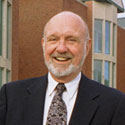
UPDATE: John Edwin Thomas passed away on Sept. 2, 2021 – https://www.wataugademocrat.com/news/asu_news/former-app-state-chancellor-john-e-thomas-dies/article_8df7bd58-6a72-52a7-888e-1fd1e9dce804.html
John Edwin Thomas, Ph.D., the fourth of eight chancellors for Appalachian State University (1979 – 1993), epitomizes the famous quote: “The two most important requirements for major success are: first, being in the right place at the right time, and second, doing something about it.” Now retired and living in Valle Crucis with his wife, Janice, John, 88, reflects on passions pursued, risks taken and legacies achieved.
“It’s been a damn good ride,” he said.
John and Janice have lived in the High Country since 1974, when he was asked to join the administration of Appalachian State University as vice chancellor for academic affairs. The move to academia was a major shift in John’s career focus. John’s varied career path actually made him uniquely qualified to lead APP STATE at a pivotal time in its history. The university recognizes John as a leader in technology and international education by contributing innovative ways for the university to achieve the expansions it sought.
John’s life story begins in Ft. Worth, Texas. He was born in 1933 into a middle-class family, two years after the Stock Crash of 1929. His father, mother, sister and he moved from Texas to Kansas City, Mo., where he attended grade school and high school. He attended Central Missouri State College for a year, taking pre-engineering courses.
“I chose engineering because I like math, so I thought I’d be good at it,” John said.
As soon as he turned 18, he enlisted in the Navy at the urging of his best buddy, who convinced him that life in San Diego, where he was based, was a lot more fun than in Missouri. After boot camp, the Navy sent him to electronics school for a year as a Seaman First Class. Then his reserve service was transferred to the Naval ROTC at the University of Kansas. He graduated in 1953 at 22 years old with a bachelor’s degree in electrical engineering. After graduation, because he was a member of the ROTC, he was called up as a Second Lieutenant reserve officer and went to boot camp again in the Marine Corps, this time in Washington, D.C.
In 1953 John was hired as an electrical engineer for Wagner Electric Corporation in St. Louis, Mo. “I wanted to be a design engineer of power transformers and work at the blackboard doing the mathematics for that,” John said. Instead, Wagner made him start out in the factory where he could see the products being made and talk with the workers.
Wagner gave John his first life lesson: Hands-on experience helped him more effectively lead others.
In 1955, John was called to active duty and sent to Camp LeJuene in Jacksonville, N.C. He was put in command of a radio relay platoon teaching electronics and supervising troops in stripping down equipment.
At one of these dances held at the camp, John met a very attractive young woman, Ellen, who had a six-year-old daughter named Laura. Ellen and John married, and in 1956 the couple decided that John should return to Wagner Electric where he could make $400 instead $250 per month as a design engineer. In a true case of being in the right place at the right time, John attended a company picnic where he met Wagner’s sales manager who offered him a job in sales.
“I decided on the spot to make a career change from design engineer to selling things.” He was moved to Kansas City.
When John decided he needed to polish up his lack of liberal arts, he enrolled in law school at the University of Missouri at Kansas City in 1957. While working in sales full-time, he took classes at night, graduated in 1961 and passed the bar exam.
Law school was the beginning of John’s second life lesson: A well-rounded education and commitment to lifelong learning helped John stay current and presented him with new career opportunities.
By then, Ellen and John had two children together, Johnny and Christa, along with Ellen’s daughter. John was promoted to district manager, and the family moved to Atlanta where he managed a sales force and worked with large customers such as Georgia Power Company.
“I was really happy. We had built a nice home near Atlanta,” John said.
Once again fate stepped in and took John’s life in a new direction, when John watched on television as Alan Shepard became the first American in space.
That was a sign for John. He decided to go into the aerospace industry. He moved his family to Cape Canaveral, where he wanted to work in the launch area.
“They said they were interested in hiring me because I had both an engineering and law degree,” John said. He joined an impressive team of experts whose one goal was to get a man on the moon and back to Earth safely by the end of the decade.
Dr. Kurt H. Debus, the first director of NASA’s John F. Kennedy Space Center, wanted to start a a master’s degree program for NASA employees in research and development management. John was asked to negotiate a contract with the State of Florida. Florida State University was very interested.
“They not only said yes, but also sent their top two professors to Cape Canaveral to work out the curriculum for a master’s degree,” John said. He was asked to be a guinea pig and enroll in the class. Of the 26 students who started in the program’s first year, John was one of about 22 who finished.
John began teaching R&D management to undergraduates at a new satellite campus for Rollins College at the Kennedy Space Center. Then, he created a satellite campus for Florida Institute of Technology at Melbourne.
In 1965, John found himself single again, this time with two children, ages 6 and 10, and one 16-year-old. Laura, who graduated from high school that year, went to live with her biological father. In 1967, he talked his “present and final wife,” Janice, into marrying him.
They eventually had two children of their own. Scott has an engineering degree from UNC at Charlotte, a master’s degree from App State and a doctorate from UNC at Charlotte. He lectures at App State in the Department of Physics and Astronomy and lives in Boone. Younger brother Brandon, a 1992 App State grad, lives in Hillsborough, N.C., where is a marketing writer with PRA Health Sciences.
“Janice and I have been married for 52 years and have had a marvelous life,” said John. “She has been a lifesaver. She took on a man who is seven years older than she is and two young children.”
In 1969, NASA gave him unpaid leave to go to Tallahassee to get a master’s degree at FSU. He graduated in 1970 with a doctorate in business administration. He knew that NASA’s Apollo program was winding down to be followed by the shuttle program. Because his real passion had been the moon landing, the challenge of working for NASA was gone for him. He decided to pursue academia.
East Texas State University needed a chairman of the General Business Department and offered the position to John. In the two years he spent there, he was promoted to dean of the College of Sciences & Technology.
Moving to academia was John’s third life lesson: To find success and fulfillment in his career, John was willing to be open to change and take risks.
When Dr. Herbert W. Wey, App State’s third chancellor approached John about becoming his vice chancellor, John responded enthusiastically.
“We just jived. He got me a lot of elbow room. When you had an idea, Herb encouraged you to take the risk.”
John remembers five projects, in particular. As vice chancellor, he created The Loft program which allowed student artists to live in a New York City loft rented by the university for at least a week. They met face-to-face with a range of practicing artists. The program is now called The Appalachian Loft.
He also helped William C. Hubbard develop a faculty development program now called the Hubbard Center for Faculty Development. The center provides funding to faculty members who have creative ideas for improving instruction.
John also spearheaded two projects focused on interconnectivity. He integrated computers throughout the university with wideband distribution. And, it was his idea to create a transportation system to help students move around the campus and community easier, especially during Boone’s inclement winters, now called AppalCART.
John is quick to broaden the conversation about his accomplishments to include those with whom he has worked. ““Good ideas come from the bowels of the ship,” he said.
“I just love App State and the High Country. I spent the better part of my career at the university.”
After John took the App State position, Janice went back to school and became a nurse. “She had a very successful career as a senior operating room nurse at Watauga Medical Center,” John said. “Our social life expanded because of all the people she came to know, and I became known as Jan’s husband. I loved it.”
John has continued to take on projects after retiring from App State. Jim Hunt, North Carolina’s governor when John retired, asked him to serve as chairman of the North Carolina Utilities Commission. He also continues to be actively involved in North Carolina’s Military Officers Association.
“Janice and I sit down on the deck of our house now and thank God for the blessings we’ve had. Even the tough years we would never change.”

 Karen J. Rieley