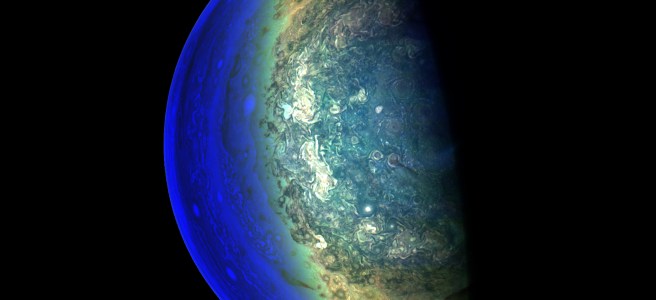
Yesterday, my husband and I had the pleasure of attending the matinee performance of Jacksonville Symphony’s “Mozart’s Jupiter” concert, part of its 2019 Masterworks Series. What an inspiring way to spend a Sunday afternoon!
Mozart’s Symphony No. 41 in C major, K. 551 was his last symphony. According to the concert’s program notes, it was given the sobriquet (which I had to look up to learn means “nickname”) of “Jupiter” by Mary and Vincent Novello, a 19th-century English couple who said that the nickname was bestowed by Johann Peter Salomon, the entrepreneur responsible for Haydn’s two visits to London in the 1790s.
JSO Associate Conductor Nathan Aspinall led the orchestra through the complex piece that takes the listener through a range of emotions, truly an apotheosis (another word to look up meaning “culmination or climax” of Mozart’s musical talents. The piece is full of syncopations and unexpected accents and harmony. The finale features a double fugue and a sonata and climaxes in a magnificent coda which interweaves all five principal themes in the symphony.
“Jupiter” was the central piece bookended by Maurice Ravel’s Le Tombeau de Couperin and Sir Edward Elgar’s Enigma Variations, Op. 36. Le Tombeau originally appeared in 1918 as a six-movement suite for solo piano. The next year Ravel orchestrated four movements. It is a lilting but melancholy piece, appropriate because Ravel dedicated it to a friend who died in combat during World War I.
My favorite piece of the concert was by a composer with whom I was not familiar, Sir Edward Elgar. I learned in the program notes that the score bears the inscription “Dedicated to my friends pictured within.” Each of the 14 variations in the piece is titled with with a monogram or a nickname referring t o members of Elgar’s circle. “C.A.E.” of the first variation is his wife, Caroline Alice Elgar; Variation II’s “H.D.S.-P.” is Hew David Steuart-Powell, pianist in Elgar’s trio (along with “B.G.N.,” Basil Gevinson, the cellist and subject of Variation XII), and so on.
The piece thus becomes a series of character sketches, which appeals to my writer side. In general, Enigma soared and flourishes and literally gave me chills. I felt my soul rise at times. It may have been for Elgar a series of variations, but for me it gave the impression of animals in nature beginning their day of roaming in the forest during morning twilight.
Speaking of morning twilight, did you know that astronomers describe it as having three stages? Astronomical dawn is when a very small portion of the Sun’s rays begin to rise above the horizon. It is so faint that you generally can’t distinguish it form night. Next is nautical dawn, the point at which the horizon becomes faintly visible, enough so that seafarers can use it as a reference point when navigating by the stars. Last is civil dawn when the sky is full of bright orange and yellow colors. Civil twilight is the period of daybreak just before sunrise, which is when the upper edge of the Sun touches the horizon.
I realize I am taking license in describing Elgar’s score differently than he may have imagined it, in the same manner that French literary critic and theorist Roland Barthes described interpreting a text in The Death of the Author. He argues against traditional literary criticism’s practice of incorporating the intentions and biographical context of an author in interpreting text. He argued instead that writing and creator are unrelated. And reader response theory goes even further by contending that, while the author creates the text, readers are the ones who create meaning by interpreting the text.
Likewise, the Jacksonville Symphony Orchestra is grooming future symphony audiences by including information about how to experience the symphony in its program. As the printed program encourages, the best way to enjoy the music is to just listen and see where it takes you. Close your eyes and imagine the memories, colors, movie scenes, images or moods the music brings to mind. Listen for patterns in rhythm, sound or melody and notice how they change.
I was very encouraged to see family’s with preteen and teenage children and young adults attending Sunday’s matinee. By encouraging them to make the music their own, the symphony is ensuring its future.
Sunday was the last performance of “Jupiter,” but you can hear some of it at https://www.jaxsymphony.org/event/mozart-jupiter/. Explore the website while you’re there and decide which future concerts you’d like to experience!

 Karen J. Rieley