Still life

It is one of the most well-known still life paintings of all time – Vincent Van Gogh’s Vase with Fifteen Sunflowers. And, yet, it is anything but still. The vibrant yellows are warm and lush. The leaves seem in motion. The vase sits jauntily on the table.

I can see that the flowers are in various stages of decomposing. Some are still perky and clearly still drinking the water in the vase that has become their life force. Others are beginning to droop, and some seem to be moments away from beginning to drop their petals. I want to check the water level in the vase and add more to keep them alive longer, but I know that if I were to disturb them, they would drop their precarious petals, and I would destroy the natural beauty of the arrangement.

No, they are just right as they are. Even as they are moving steadily toward their inevitable death, they are beautiful and still have much to offer. There is still life in them until their final decomposition.

I know there is something more happening here, if I can but accept it. We each still have life as well, even as we age. This has been a hard realization for me, that we can lose our youth and still have value. I knew I would age, or at least I hoped I’d still be around to age. I didn’t know that my value would be questioned, even by myself and even more by others. I knew my husband would age. I didn’t expect his mortality to become questionable at so young an age, and I didn’t expect him to change. I guess I thought that we’d get older but that otherwise our lives wouldn’t change. Naive, I know.

If I can hold onto this image of Van Gogh’s fifteen flowers, I can better accept that we each are different and are going through stages at our own pace as we move from this life to afterlife. We can still be vibrant and warm, even as we begin to age. We are still life forces, stubborn individuals, a little frayed around the edges and about to drop some petals, but beautiful all the while. It would not do to try to change us. We fit into the picture just fine as we are. Still here, still life, not so still after all.

Five Tips for Handling Negative Social Media Comments

Infographic vector created by Freepik

When an implication arises that your company may have done something wrong, you can assume that at least for the foreseeable future, the news media will produce stories about the situation. Dealing with traditional media – TV and newspapers primarily – is an important function of public relations. Equally important, however, is dealing with social media. Access to social media gives individuals the opportunity to easily and broadly express opinions to what they hear in the media.

As PR practitioners, we should expect that some of these comments will not be positive. Competitors and disgruntled customers, vendors and former employees may use social media as their opportunity to get back at our company or further their own interests.

Your company needs to have a united response to comments, whether the responses are positive or negative, right or wrong. The company’s ability to come out of this critical time strong and capable of continuing to provide its products or services will be affected by its leaders’ and, in fact, all levels of employees’ ability to come to common agreement about how negative comments will be handled. Consider these five ways to handle negative social media comments:

  1. Deciding whether to respond to a negative comment about our business depends greatly on where the comment appeared and how many of our current and potential customers are likely to be influenced by the comment. For example, negative comments on a news medium’s Facebook page generally fade away quickly, because most people don’t read them to begin with and because current news stories are quickly replaced by more and more news. Monitoring whether any of those negative comments are shared out is important, however, because once they appear on a personal Facebook page, friends of that page will read the comment and respond to it and/or share it out to their friends. People do have a tendency to distrust or question what appears in the media; on the other hand, they tend to trust and are influenced heavily by their friends’ opinions.
  2. Often, it is best to simply keep our cool and not respond to negative comments. Responding just keeps the comment string alive and, in reality, if someone is still disgruntled even after our business has tried to rectify the situation, there is little we can do to change the person’s mind. If we feel we need to respond, we should state the facts of the case without placing any blame on the other person (even if it was their fault).
  3. If we read a negative comment that we feel may be justified, we should respond by giving the person an opportunity to communicate offline with us, to see if we can rectify the situation. If we are able to come to a positive resolution, we may ask the person to post a positive comment about how the company worked to resolve the issue.
  4. We do need to respond – politely and has succinctly as possible – to correct misinformation in a comment; for example, a misconception that we no longer offer a service that, in fact, we still do. If the incorrect information about how bad our company is continues to be spread, we may need to consider lawsuit for slander, libel or defamation of character.
  5. Any response we make should come from one person in the company to ensure that we have a unified message. Make sure all employees know that if they read a negative comment anywhere, they should email this designated person with a link to where to find the comment. The designated person will need to make the decision whether and how to respond.

The strength of a company never shows stronger than during a crisis. Be very careful , in asking employees to support the company by monitoring but not engaging in social media comments, that you are telling them the truth about the situation that has caused the crisis as you best know it at the time. This is a watershed moment when your company can either emerge stronger by working together or in chaos if your employees feel they have been kept in the dark or told lies. Continue to give them reasons to be proud of the company for which they work, even in the face of negativity.

Enjoying Your Work is YOUR Responsibility, Not Your Employers’

My current employer, Keystone Behavioral Pediatrics, is one of the best organizations for which I’ve worked. While no job is perfect, my job marketing Keystone is made so much easier and satisfying because the parents who bring their children to us are pleased with how we have helped their children and eager to tell other parents about us. Pediatricians, guidance counselors and daycare directors, in particular, feel comfortable referring their children to us. We have so many parents who want us to work with their children that we are hiring more therapists to work with them – a great success that I love hearing, given my role as marketing and communications director!

Sharing wisdom that comes from experience is often not appreciated, I know, but I feel compelled to share what I have learned in my 40 years of professional work for a variety of employers – public and private, nonprofit and for-profit. A company like Keystone that is rapidly growing inevitably feels some stress. Employees need to be flexible, enjoy teamwork and be willing to stretch to provide consistently great service to growing numbers of clients. I personally thrive in such an entrepreneurial environment, because I like feeling that I’m integral to the company’s success.

I well know that not all of my contemporaries agree with my philosophy, but I have to say that I cannot accept the idea that an employer needs to change the workplace to accommodate its youngest, least experienced employees at the expense of those who are leading the company and bear the financial responsibility for keeping the business alive. I well remember what it was like in my first job. I was hired to work in the corporate headquarters of a large international company. There were very few women in leadership period, much less young people who were emerging from the 1970s and its make love not war, feminism, antiwar and Watergate themes.

The corporate environment then was straight out of “The Man in the Grey Flannel Suit” movie, which means not a lot had changed since the mid-50s. Older, white men, in very conservative suits and ties sat behind big wooden desks, while the rest of us toiled away in our little offices with gray metal office furniture. In my case, as a young woman, it was hard to get anyone to take me seriously – even the all-female administrative staff (called secretaries then) resented me. I guess they thought I thought I was better than they were, because I was a supervisor and invited to sit at business meetings rather than having to serve coffee and take minutes at meetings like they did.

No one asked me what would make me feel happier about my work. They expected me to learn how to work within their environment. They assumed I would learn my job quickly, show up at work on time, work longer hours if necessary to make a deadline, dress like a businessperson (which meant skirts and jackets, hose and high heels most of the time) and treat my bosses with deference and respect.

It was overwhelming – my first time living away from home in a northern city – but I’m proud to say that I prevailed and was regularly promoted. The president of the company even sent a letter home to my parents telling them how impressed he was with my performance and could only wish that his children would do as well.

Today’s youngest employees, however, seem to particularly struggle in such workplaces, probably because they have been reared with different expectations than my generation. We were reared with a “root little pig or die” work ethic. We thought we had to over-perform to keep our job. We felt lucky to even have a job and worried nearly constantly about whether we would keep our job. We would never admit we couldn’t do something an employer asked us to do and had a “fake it ’til you make it” mindset.

Millennials, on the other hand, have been coached their entire lives and tend to assume that employers will coach them, too. But, employers don’t want to be parents and most don’t have the time or money to hold employees’ hands or allow employees to learn on the job.

Millennials tend to work only the minimum time expected and push for flexibility and a reduced work schedule to create more time for other pursuits. Employers find their attitudes disrespectful and irresponsible.

Millennials are vocal about wanting work to be a “fun” place to go with lots of cool perks and benefits. Employers come to resent that what they are able and willing to do for employees quickly becomes an expectation and unappreciated.

The reality is that Millennials (like all workers) must learn to find intrinsic motivation (internal drive for work), so they can find real satisfaction and success in their careers. Since Millennials haven’t learned this yet, they’re experiencing sadness and confusion in the workplace. Unfortunately, their unhappiness is transparent to employers who have no desire to pay for what they perceive as a bad attitude at work.

Millennials need to learn how a business works. For example, Keystone Behavioral Pediatrics wants to help all children be successful. To be able to hire and pay staff and provide staff with an appropriate workplace to work with children, Keystone has to receive revenue. That revenue comes from parents/caregivers and is based on the billable hours our therapists spend helping their children. Parents and their insurance companies won’t pay for time that doesn’t directly benefit their children. Why would they? And, if they don’t pay Keystone, Keystone can’t pay its employees.

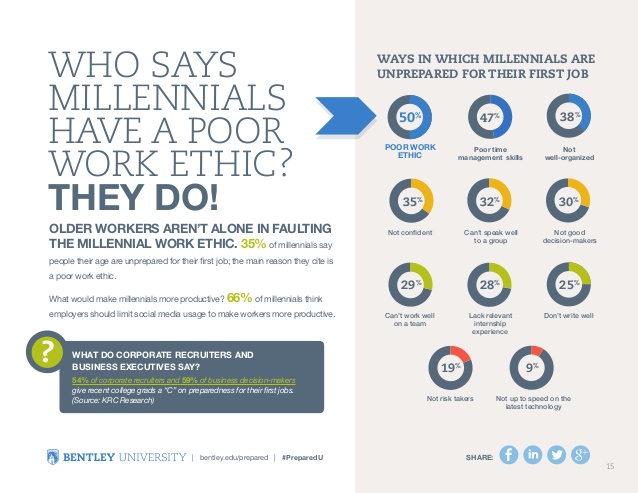
Millenials also need to learn what motivates their employers to hire them, keep them employed and promote them. I’ve shared some of my generation’s experiences and expectations. This graphic shares more:

preparedu-the-millennial-mind-goes-to-work-16-638

I know some very special Millennials who won’t like being described as this graphic does. This isn’t meant to offend anyone. It is meant as advice, in that if you know that you are being cast in a group in ways you don’t want, then you know what you have to do to set yourself apart.

Lastly, I want to share some tips that my peers and I have learned as employees and employers about how to say goodbye gracefully when leaving a job. I hope it will help former employees avoid getting bad reputations as problem employees so that they can be successful in future jobs:

  • Don’t curse, yell or insult people or damage company property.
  • Don’t bad-mouth your boss or company in later job interviews or in social media; future employers should know that if you’ll say negative things about a former employer, you will no doubt say negative things about them in the future.
  • Remain respectful and professional; don’t burn bridges. The community you live and work in is smaller and tighter than you think, and you may need/want a former employer’s help some day.
  • After biting your tongue at work and in social media, find a friend or family member who will let you blow off steam.
  • Take the high road and always remember that “what goes around, comes around.”

Work should be fulfilling and something that you are proud of doing. Achieving that is within your power, as an employee, wherever you work.

Miracle Workers: Patrons of the Hearts Giving the Gift of Life

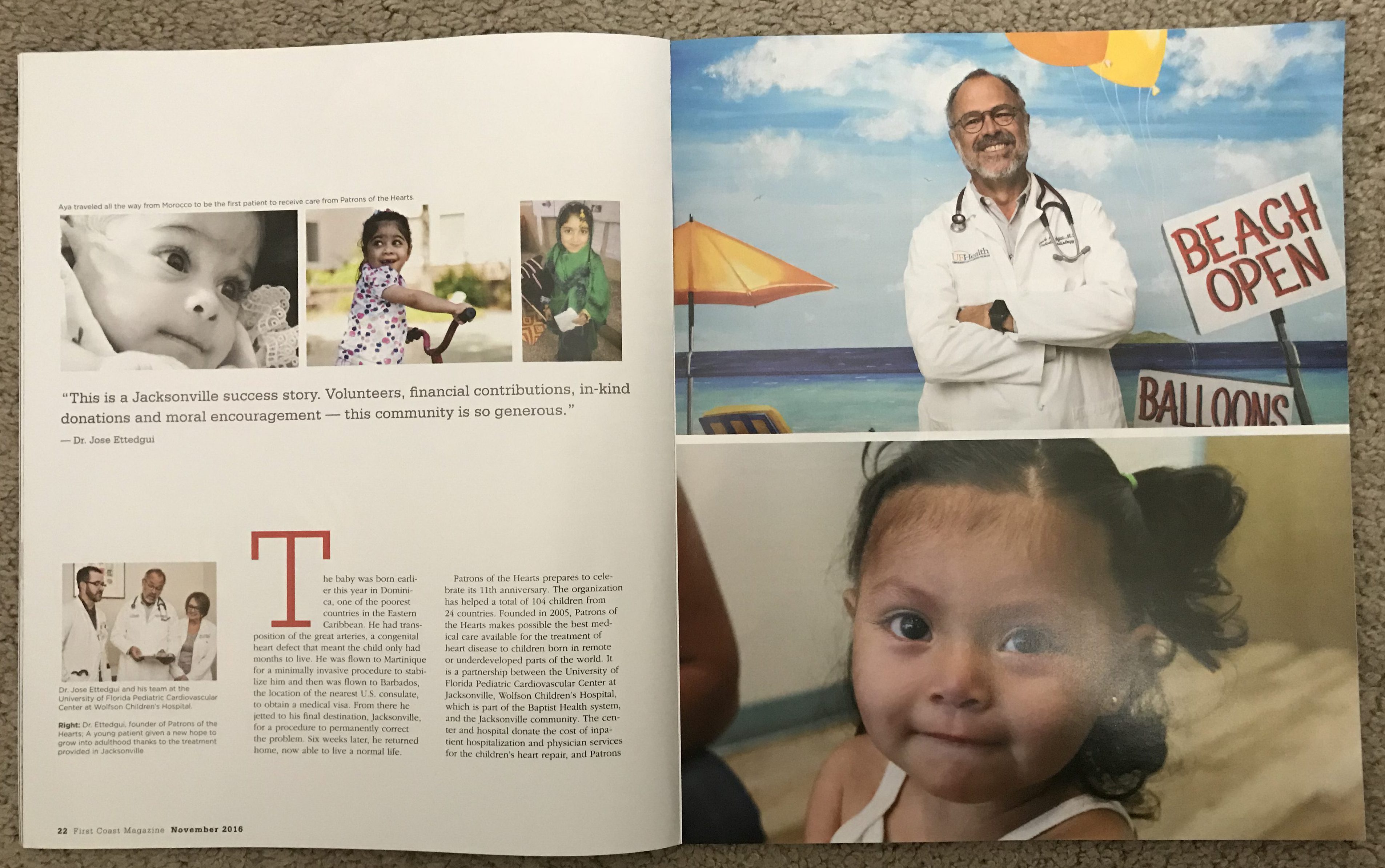
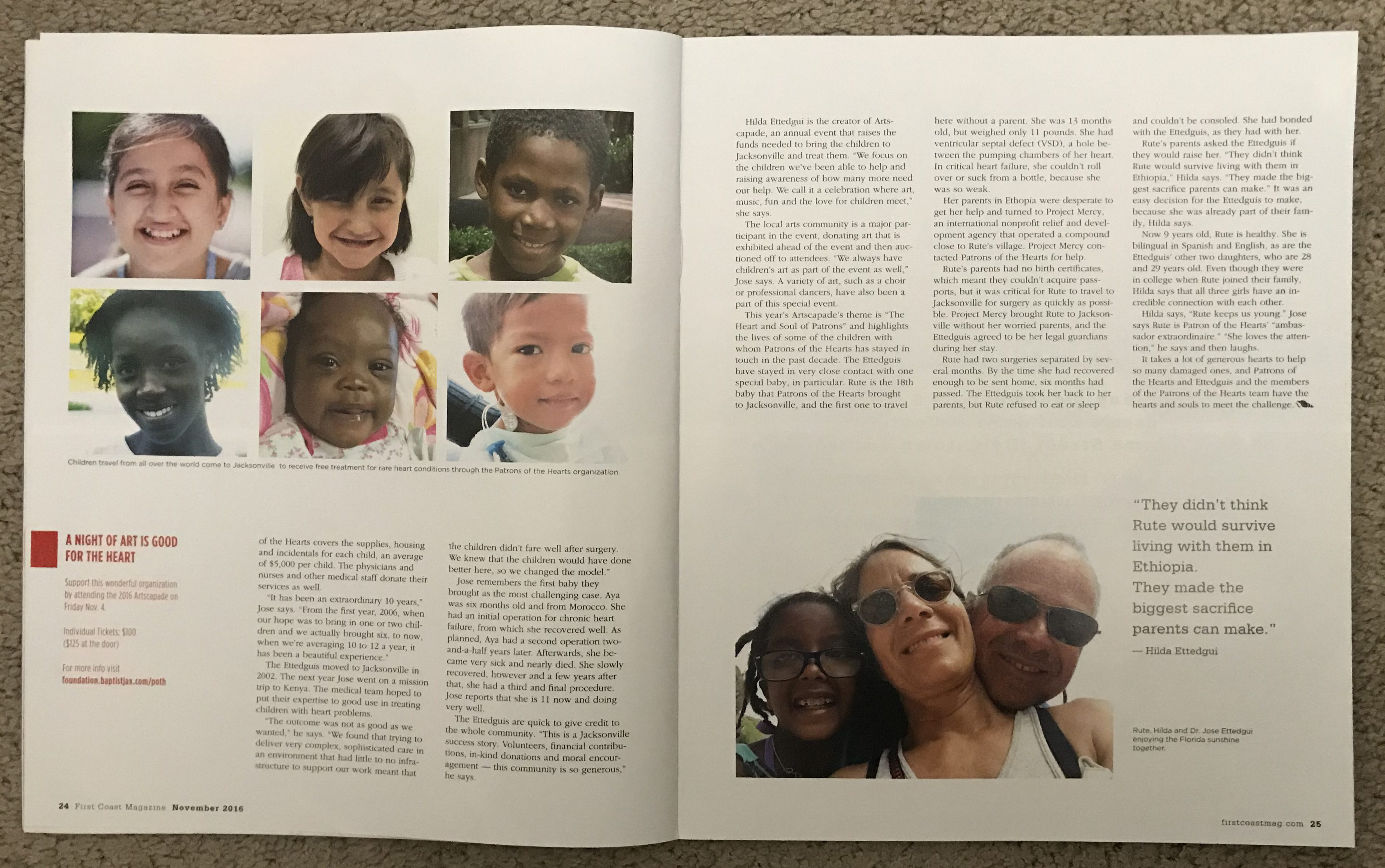
ettedgui-familyMy fifth story appeared in the “High Tide Features” section of First Coast Magazine and was the longest one I’ve been asked to write for the magazine to date. It was very special to write, because the Ettedjuis are such a wonderful couple – they have had the means, influence, talent and passion to help so many children with heart defects from around the world. I hope you take the time to read about this special couple and their wonderful organization, Patrons of the Hearts.

The baby was born earlier this year in Dominica, one of the poorest countries in the Eastern Caribbean. He had transposition of the great arteries, a congenital heart defect that meant the child only had months to live. He was flown to Martinique for a minimally invasive procedure to stabilize him and then was flown to Barbados, the location of the nearest U.S. consulate, to obtain a medical visa. From there he jetted to his final destination, Jacksonville, for a procedure to permanently correct the problem. Six weeks later, he returned home, now able to live a normal life.

Patrons of the Hearts prepares to celebrate its 11th anniversary. The organization has helped a total of 104 children from 24 countries. Founded in 2005, Patrons of the Hearts makes possible the best medical care available for the treatment of heart disease to children born in remote or underdeveloped parts of the world. It is a partnership between the University of Florida Pediatric Cardiovascular Center at Jacksonville, Wolfs Children’s Hospital, which is part of the Baptist Health system and the Jacksonville community. The center and hospital donate the cost of inpatient hospitalization and physician services for the children’s heart repair, and Patrons of the Hearts covers the supplies, housing and incidentals for each child, an average of $5,000 per child. The physicians and nurses and other medical staff donate their services as well.

“It has been an extraordinary 10 years,” Jose says. “From the first year, 2006, when our hope was to bring in one or two children and we actually brought six, to now, when we’re averaging 10 to 12 a year, it has been a beautiful experience.”

The Ettedguis moved to Jacksonville in 2002. The next year Jose went on a mission trip to Kenya. The medical team hoped to put their expertise to good use in treating children with heart problems.

“The outcome was not as good as we wanted,” he says. “We found that trying to deliver very complex, sophisticated care in an environment that had little to no infrastructure to support our work meant that the children didn’t fare well after surgery. We knew that the children would have done better here, so we changed model.
Jose remembers the first baby they brought as the most challenging case. Aya was six months old and from Morocco. She had an initial operation for chronic heart failure, from which she recovered well. As planned, Aya had a second operation two-and-a-half years later. Afterwards, she became very sick and nearly died. She slowly recovered, however, and a few years after that, she had a third and final procedure. Jose reports that she is 11 now and doing very well.

The Ettedguis are quick to give credit to the whole community. “This is a Jacksonville success story. Volunteers, financial contribution, in-kind donations and moral encouragement – this community is so generous,” he says.

Hilda Ettedgui is the creator of Artscapade, an annual event that raises the funds needed to bring the children to Jacksonville and treat them. “We focus on the children we’ve been able to help and on raising awareness of how many more need our help. We call it a celebration, where art, music, fun and the love for children meet,’ she says.

The local arts community is a major participant in the event, donating art that is exhibited ahead of the event and then auctioned off to attendees. “We always have children’s art as part of the event as well,” Jose says. A variety of art, such as a choir or professional dancers, have also been part of this special event.”

This year’s Artscapade’s theme is “The Heart and Soul of Patrons” and highlights the lives of some of the children with whom Patrons of the Hearts has stayed in touch in the past decade. The Ettedguis have stayed in very close contact with one special baby, in particular. Rute is the 18th baby that Patrons of the Hearts brought to Jacksonville and the first one to travel here without a parent. She was 13 months old but weighed only 11 pounds. She had ventricular septal defect (VSD), a hole between the pumping chambers of her heart. In critical heart failure, she couldn’t roll over or suck from a bottle, because she was so weak.
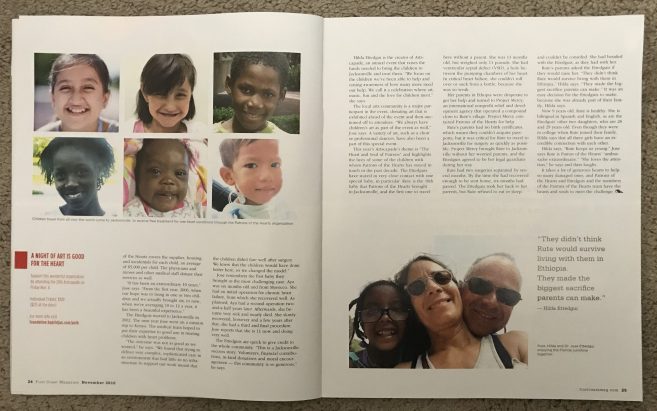
Her parents in Ethiopia were desperate to get her help and turned to Project Mercy, an international nonprofit relief and development agency that operated a compound close to Rute’s village. Project Mercy contacted Patrons of the Hearts for help.

Rute’s parents had no birth certificates, which meant they couldn’t acquire passports, but it was critical for Rute to travel to Jacksonville for surgery as quickly as possible. Project Mercy brought Rute to Jacksonville without her worried parents, and the Ettedguis agreed to be her legal guardians during her stay.

Rute had two surgeries separated by several months. By the time she had recovered enough to be sent home, six months has passed. The Ettedguis took her back to her parents, but Rute refused to eat or sleep and couldn’t be consoled. She had bonded with the Ettedguis, as they had with her.

Rute’s parents asked the Ettedguis if they would raise her. “They didn’t think Rute would survive living with them in Ethiopia,” Hilda says. “They made the biggest sacrifice parents can make.” It was an easy decision for the Ettedguis to make, because she was already part of their family, Hilda says.

Now 9 years old, Rute is healthy. She is bilingual in Spanish and English, as are the Ettedguis’ other two daughters, who are 28 and 29 years old. Even though they were in college when Rute joined their family, Hilda says that all three girls have an incredible connection with each other.

Hilda says, “Rute keeps us young,” Jose says Rute is Patron of the Hearts’ “ambassador extraordinaire,”

“She loves the attention,” he says and then laughs.

It takes a lot of generous hearts to help so many damaged ones, and Patrons of the Hearts and Ettedguis and the members of the Patrons of the Hearts team have the hearts and souls to meet the challenge.