Grant Writing Fundamentals

I enjoyed catching up with Christine Rothberg, with whom I used to work at Lutheran Social Services and meeting future social workers during Christine’s class yesterday evening at the University of North Florida. She is doing great work in preparing these students for multi-method clinical and administrative practice with individuals, families, groups, organizations and communities by teaching them about biopsychosocial-economic and spiritual wellbeing.

Christine invited me to speak to her students about the role of grant writing in social work, something I have done in some form or another for the past 37 years. I enjoyed my time with the students. I assured them that, if they are interested in writing grants or perhaps asked to take on that role for their future employers, they can bring a unique perspective to the role, because unlike those of us who come to the role with a writing background and expertise, they can approach a grant application as someone “on the ground,” who knows the program/project and the need. My goal for the class was to give them a structure to work within to produce the most convincing request possible.

I saw this quote somewhere that I cannot now find – “Grant makers are in the business of funding ideas, as opposed to merely providing funds for things.” Writing grant applications may sound perfunctory, but I would submit that grants are what allow a nonprofit to dream, expand and re-invent itself. While donations from individuals are the backbone of an organization, grants fund projects and programs that meet specific needs the organization has identified and that enable it to provide better service.

Grant writers have the opportunity to work closely with other areas of the nonprofit, especially the program director/manager for the project that needs funding, the director/vice president of operations, the finance director/chief financial officer and the resource development director/chief advancement officer, to develop a sound proposal tailored to the specific funder being solicited.

To that end, an effective grant writer needs to be a critical thinker, someone able to see issues, needs and challenges from all sides – the organization’s, the community’s and the grantor’s, specifically. The following points may help a grant writer achieve this omniscient point of view: 

  • Ask yourself what would motivate, engage, inspire and fundamentally change the lives of the people (or other living creatures) you hope to help. How will the resources for which you are asking for funding accomplish that goal? What positive outcome(s) will the funding realize?
  • Research is critical. Conducting targeted research helps you find the right funders to partner with and support your organization’s work. Sending the right proposal to the right funder is key to finding the match. Get to know potential grant-makers better by obtaining copies of their annual reports. Scrutinize their website. What buzz words do they use? Most importantly, request a copy of the grant guidelines, if they are not available online. Follow the requirements of the funding notice or application strictly. Your guide for what to include or not to include in your document is the request for proposal (RFP) or grant application. Give the funder exactly what they ask for, no more and no less.
  • Present a logical solution to a problem. Think of your proposal as a story with a beginning (the problem or opportunity is the need statement), middle (the solution is your program), and end (the results are your outcomes). The solution to the presented problem needs to make sense. Tell the reader right up front what you are going to do, who is going to benefit and why they should care.
  • Convince the funder you know what you’re doing. The proposal should demonstrate that you have a clear understanding of the need in your community and a strong programmatic response. After reading your proposal, the funder should feel confident that your organization would be a responsible steward of their funds. Present a solid plan and highlight the skills and experience of your leaders. Show how your organization is uniquely able to solve an issue by providing the service for which you are requesting funding.
  • Make sure the budget and the proposal narrative match. The project budget is another opportunity to tell your story and demonstrate your credibility. Keep in mind that the budget is often the first thing funders study. Everything in your budget should be reflected in the narrative.
  • Give the funder reasons to care about those you are helping. Allow the funder to “see” a person helped by including testimonials and/or success stories in your grant application.
  • Remember that funders are people. Pick up the phone and call (when appropriate) instead of relying solely on email. Even better, make sure that your CEO, development officer and board of directors are aware of which funders you are approaching. If they have connections with the funders, a phone call or email from them to the funder ahead of time will improve your proposal’s chances of funding. Foundation fundraising (like all fundraising) is about relationships. Some funders require a site visit of those organizations they are most interested in funding. Offer a funder a site visit, if not required, both before and after receiving the grant. Remember to thank the funder for taking the time to consider your application, whether you receive the grant or not. You may well get another chance to apply, and you want to leave things on good terms.

Core Elements of a Grant Proposal:

  • An abstract, or summary, that introduces the project and argues for its need.
  • Background information on your organization, which may include an outline of its history, key leadership, demographics and special programs, among other items. In this section, assure funders that yours is a viable and trustworthy institution that will use awarded funds well.
  • A needs or problem statement that draws on facts, data and research to justify the importance of your project.
  • A description of the program chronicling your solution to the problem set forth in the preceding section.
  • A description of the program’s outcomes, highlighting what will change as a result of it.
  • Evaluation criteria demonstrating how you will measure whether or not the program’s goals have been met.
  • Other funding sources that you’ve petitioned for support.
  • Projections of sustainability and future funding, to show that it will continue beyond their donation.
  • A budget that shows project costs.
  • Any requested supplemental materials and a cover letter. Typical attachments/supplemental materials requested include:
  • IRS 501(c)(3) Determination Letter – A vital document that every 501(c)(3) organization must keep safe. State laws vary, but in order to keep nonprofit status current, the group may be required to file a copy of the determination letter with the state agency that registers nonprofits.
  • IRS Form 990 – A United States Internal Revenue Service form that provides the public with financial information about a nonprofit organization. It is often the only source of such information. It is also used by government agencies to prevent organizations from abusing their tax-exempt status.
  • Current Organization Operating Budget
  • Project/Program Budget
  • Financial Statements for the previous two years (audited, preferably)
  • Organization’s Most Recent Audit

Most foundations and grantors, private and public, have online applications with specific information and usually maximum character/word counts; however, some family foundations and individuals still prefer a letter proposal format that may be emailed or mailed as a hard copy. Often private foundations will dictate a maximum number of pages allowed. Regardless, in all cases, pay close attention to stated limits.

Five Tips for Handling Negative Social Media Comments

Infographic vector created by Freepik

When an implication arises that your company may have done something wrong, you can assume that at least for the foreseeable future, the news media will produce stories about the situation. Dealing with traditional media – TV and newspapers primarily – is an important function of public relations. Equally important, however, is dealing with social media. Access to social media gives individuals the opportunity to easily and broadly express opinions to what they hear in the media.

As PR practitioners, we should expect that some of these comments will not be positive. Competitors and disgruntled customers, vendors and former employees may use social media as their opportunity to get back at our company or further their own interests.

Your company needs to have a united response to comments, whether the responses are positive or negative, right or wrong. The company’s ability to come out of this critical time strong and capable of continuing to provide its products or services will be affected by its leaders’ and, in fact, all levels of employees’ ability to come to common agreement about how negative comments will be handled. Consider these five ways to handle negative social media comments:

  1. Deciding whether to respond to a negative comment about our business depends greatly on where the comment appeared and how many of our current and potential customers are likely to be influenced by the comment. For example, negative comments on a news medium’s Facebook page generally fade away quickly, because most people don’t read them to begin with and because current news stories are quickly replaced by more and more news. Monitoring whether any of those negative comments are shared out is important, however, because once they appear on a personal Facebook page, friends of that page will read the comment and respond to it and/or share it out to their friends. People do have a tendency to distrust or question what appears in the media; on the other hand, they tend to trust and are influenced heavily by their friends’ opinions.
  2. Often, it is best to simply keep our cool and not respond to negative comments. Responding just keeps the comment string alive and, in reality, if someone is still disgruntled even after our business has tried to rectify the situation, there is little we can do to change the person’s mind. If we feel we need to respond, we should state the facts of the case without placing any blame on the other person (even if it was their fault).
  3. If we read a negative comment that we feel may be justified, we should respond by giving the person an opportunity to communicate offline with us, to see if we can rectify the situation. If we are able to come to a positive resolution, we may ask the person to post a positive comment about how the company worked to resolve the issue.
  4. We do need to respond – politely and has succinctly as possible – to correct misinformation in a comment; for example, a misconception that we no longer offer a service that, in fact, we still do. If the incorrect information about how bad our company is continues to be spread, we may need to consider lawsuit for slander, libel or defamation of character.
  5. Any response we make should come from one person in the company to ensure that we have a unified message. Make sure all employees know that if they read a negative comment anywhere, they should email this designated person with a link to where to find the comment. The designated person will need to make the decision whether and how to respond.

The strength of a company never shows stronger than during a crisis. Be very careful , in asking employees to support the company by monitoring but not engaging in social media comments, that you are telling them the truth about the situation that has caused the crisis as you best know it at the time. This is a watershed moment when your company can either emerge stronger by working together or in chaos if your employees feel they have been kept in the dark or told lies. Continue to give them reasons to be proud of the company for which they work, even in the face of negativity.

Enjoying Your Work is YOUR Responsibility, Not Your Employers’

My current employer, Keystone Behavioral Pediatrics, is one of the best organizations for which I’ve worked. While no job is perfect, my job marketing Keystone is made so much easier and satisfying because the parents who bring their children to us are pleased with how we have helped their children and eager to tell other parents about us. Pediatricians, guidance counselors and daycare directors, in particular, feel comfortable referring their children to us. We have so many parents who want us to work with their children that we are hiring more therapists to work with them – a great success that I love hearing, given my role as marketing and communications director!

Sharing wisdom that comes from experience is often not appreciated, I know, but I feel compelled to share what I have learned in my 40 years of professional work for a variety of employers – public and private, nonprofit and for-profit. A company like Keystone that is rapidly growing inevitably feels some stress. Employees need to be flexible, enjoy teamwork and be willing to stretch to provide consistently great service to growing numbers of clients. I personally thrive in such an entrepreneurial environment, because I like feeling that I’m integral to the company’s success.

I well know that not all of my contemporaries agree with my philosophy, but I have to say that I cannot accept the idea that an employer needs to change the workplace to accommodate its youngest, least experienced employees at the expense of those who are leading the company and bear the financial responsibility for keeping the business alive. I well remember what it was like in my first job. I was hired to work in the corporate headquarters of a large international company. There were very few women in leadership period, much less young people who were emerging from the 1970s and its make love not war, feminism, antiwar and Watergate themes.

The corporate environment then was straight out of “The Man in the Grey Flannel Suit” movie, which means not a lot had changed since the mid-50s. Older, white men, in very conservative suits and ties sat behind big wooden desks, while the rest of us toiled away in our little offices with gray metal office furniture. In my case, as a young woman, it was hard to get anyone to take me seriously – even the all-female administrative staff (called secretaries then) resented me. I guess they thought I thought I was better than they were, because I was a supervisor and invited to sit at business meetings rather than having to serve coffee and take minutes at meetings like they did.

No one asked me what would make me feel happier about my work. They expected me to learn how to work within their environment. They assumed I would learn my job quickly, show up at work on time, work longer hours if necessary to make a deadline, dress like a businessperson (which meant skirts and jackets, hose and high heels most of the time) and treat my bosses with deference and respect.

It was overwhelming – my first time living away from home in a northern city – but I’m proud to say that I prevailed and was regularly promoted. The president of the company even sent a letter home to my parents telling them how impressed he was with my performance and could only wish that his children would do as well.

Today’s youngest employees, however, seem to particularly struggle in such workplaces, probably because they have been reared with different expectations than my generation. We were reared with a “root little pig or die” work ethic. We thought we had to over-perform to keep our job. We felt lucky to even have a job and worried nearly constantly about whether we would keep our job. We would never admit we couldn’t do something an employer asked us to do and had a “fake it ’til you make it” mindset.

Millennials, on the other hand, have been coached their entire lives and tend to assume that employers will coach them, too. But, employers don’t want to be parents and most don’t have the time or money to hold employees’ hands or allow employees to learn on the job.

Millennials tend to work only the minimum time expected and push for flexibility and a reduced work schedule to create more time for other pursuits. Employers find their attitudes disrespectful and irresponsible.

Millennials are vocal about wanting work to be a “fun” place to go with lots of cool perks and benefits. Employers come to resent that what they are able and willing to do for employees quickly becomes an expectation and unappreciated.

The reality is that Millennials (like all workers) must learn to find intrinsic motivation (internal drive for work), so they can find real satisfaction and success in their careers. Since Millennials haven’t learned this yet, they’re experiencing sadness and confusion in the workplace. Unfortunately, their unhappiness is transparent to employers who have no desire to pay for what they perceive as a bad attitude at work.

Millennials need to learn how a business works. For example, Keystone Behavioral Pediatrics wants to help all children be successful. To be able to hire and pay staff and provide staff with an appropriate workplace to work with children, Keystone has to receive revenue. That revenue comes from parents/caregivers and is based on the billable hours our therapists spend helping their children. Parents and their insurance companies won’t pay for time that doesn’t directly benefit their children. Why would they? And, if they don’t pay Keystone, Keystone can’t pay its employees.

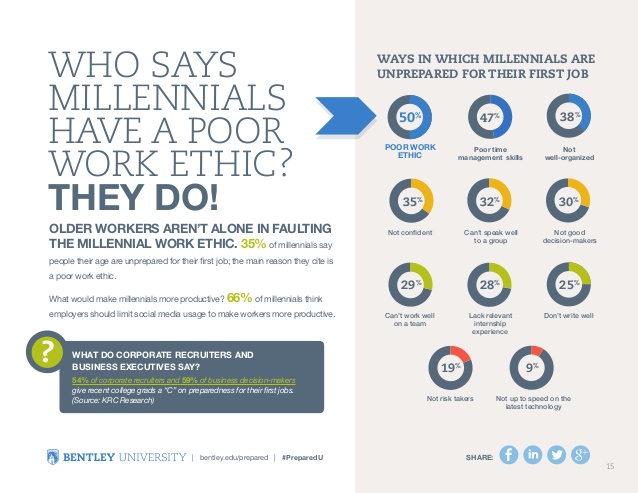
Millenials also need to learn what motivates their employers to hire them, keep them employed and promote them. I’ve shared some of my generation’s experiences and expectations. This graphic shares more:

preparedu-the-millennial-mind-goes-to-work-16-638

I know some very special Millennials who won’t like being described as this graphic does. This isn’t meant to offend anyone. It is meant as advice, in that if you know that you are being cast in a group in ways you don’t want, then you know what you have to do to set yourself apart.

Lastly, I want to share some tips that my peers and I have learned as employees and employers about how to say goodbye gracefully when leaving a job. I hope it will help former employees avoid getting bad reputations as problem employees so that they can be successful in future jobs:

  • Don’t curse, yell or insult people or damage company property.
  • Don’t bad-mouth your boss or company in later job interviews or in social media; future employers should know that if you’ll say negative things about a former employer, you will no doubt say negative things about them in the future.
  • Remain respectful and professional; don’t burn bridges. The community you live and work in is smaller and tighter than you think, and you may need/want a former employer’s help some day.
  • After biting your tongue at work and in social media, find a friend or family member who will let you blow off steam.
  • Take the high road and always remember that “what goes around, comes around.”

Work should be fulfilling and something that you are proud of doing. Achieving that is within your power, as an employee, wherever you work.