My current employer, Keystone Behavioral Pediatrics, is one of the best organizations for which I’ve worked. While no job is perfect, my job marketing Keystone is made so much easier and satisfying because the parents who bring their children to us are pleased with how we have helped their children and eager to tell other parents about us. Pediatricians, guidance counselors and daycare directors, in particular, feel comfortable referring their children to us. We have so many parents who want us to work with their children that we are hiring more therapists to work with them – a great success that I love hearing, given my role as marketing and communications director!
Sharing wisdom that comes from experience is often not appreciated, I know, but I feel compelled to share what I have learned in my 40 years of professional work for a variety of employers – public and private, nonprofit and for-profit. A company like Keystone that is rapidly growing inevitably feels some stress. Employees need to be flexible, enjoy teamwork and be willing to stretch to provide consistently great service to growing numbers of clients. I personally thrive in such an entrepreneurial environment, because I like feeling that I’m integral to the company’s success.
I well know that not all of my contemporaries agree with my philosophy, but I have to say that I cannot accept the idea that an employer needs to change the workplace to accommodate its youngest, least experienced employees at the expense of those who are leading the company and bear the financial responsibility for keeping the business alive. I well remember what it was like in my first job. I was hired to work in the corporate headquarters of a large international company. There were very few women in leadership period, much less young people who were emerging from the 1970s and its make love not war, feminism, antiwar and Watergate themes.
The corporate environment then was straight out of “The Man in the Grey Flannel Suit” movie, which means not a lot had changed since the mid-50s. Older, white men, in very conservative suits and ties sat behind big wooden desks, while the rest of us toiled away in our little offices with gray metal office furniture. In my case, as a young woman, it was hard to get anyone to take me seriously – even the all-female administrative staff (called secretaries then) resented me. I guess they thought I thought I was better than they were, because I was a supervisor and invited to sit at business meetings rather than having to serve coffee and take minutes at meetings like they did.
No one asked me what would make me feel happier about my work. They expected me to learn how to work within their environment. They assumed I would learn my job quickly, show up at work on time, work longer hours if necessary to make a deadline, dress like a businessperson (which meant skirts and jackets, hose and high heels most of the time) and treat my bosses with deference and respect.
It was overwhelming – my first time living away from home in a northern city – but I’m proud to say that I prevailed and was regularly promoted. The president of the company even sent a letter home to my parents telling them how impressed he was with my performance and could only wish that his children would do as well.
Today’s youngest employees, however, seem to particularly struggle in such workplaces, probably because they have been reared with different expectations than my generation. We were reared with a “root little pig or die” work ethic. We thought we had to over-perform to keep our job. We felt lucky to even have a job and worried nearly constantly about whether we would keep our job. We would never admit we couldn’t do something an employer asked us to do and had a “fake it ’til you make it” mindset.
Millennials, on the other hand, have been coached their entire lives and tend to assume that employers will coach them, too. But, employers don’t want to be parents and most don’t have the time or money to hold employees’ hands or allow employees to learn on the job.
Millennials tend to work only the minimum time expected and push for flexibility and a reduced work schedule to create more time for other pursuits. Employers find their attitudes disrespectful and irresponsible.
Millennials are vocal about wanting work to be a “fun” place to go with lots of cool perks and benefits. Employers come to resent that what they are able and willing to do for employees quickly becomes an expectation and unappreciated.
The reality is that Millennials (like all workers) must learn to find intrinsic motivation (internal drive for work), so they can find real satisfaction and success in their careers. Since Millennials haven’t learned this yet, they’re experiencing sadness and confusion in the workplace. Unfortunately, their unhappiness is transparent to employers who have no desire to pay for what they perceive as a bad attitude at work.
Millennials need to learn how a business works. For example, Keystone Behavioral Pediatrics wants to help all children be successful. To be able to hire and pay staff and provide staff with an appropriate workplace to work with children, Keystone has to receive revenue. That revenue comes from parents/caregivers and is based on the billable hours our therapists spend helping their children. Parents and their insurance companies won’t pay for time that doesn’t directly benefit their children. Why would they? And, if they don’t pay Keystone, Keystone can’t pay its employees.
Millenials also need to learn what motivates their employers to hire them, keep them employed and promote them. I’ve shared some of my generation’s experiences and expectations. This graphic shares more:
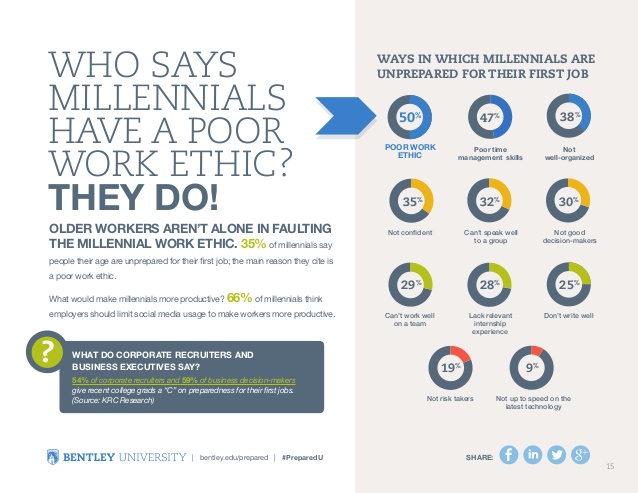
I know some very special Millennials who won’t like being described as this graphic does. This isn’t meant to offend anyone. It is meant as advice, in that if you know that you are being cast in a group in ways you don’t want, then you know what you have to do to set yourself apart.
Lastly, I want to share some tips that my peers and I have learned as employees and employers about how to say goodbye gracefully when leaving a job. I hope it will help former employees avoid getting bad reputations as problem employees so that they can be successful in future jobs:
- Don’t curse, yell or insult people or damage company property.
- Don’t bad-mouth your boss or company in later job interviews or in social media; future employers should know that if you’ll say negative things about a former employer, you will no doubt say negative things about them in the future.
- Remain respectful and professional; don’t burn bridges. The community you live and work in is smaller and tighter than you think, and you may need/want a former employer’s help some day.
- After biting your tongue at work and in social media, find a friend or family member who will let you blow off steam.
- Take the high road and always remember that “what goes around, comes around.”
Work should be fulfilling and something that you are proud of doing. Achieving that is within your power, as an employee, wherever you work.
 Karen J. Rieley