This is Jacksonville

Karen Rieley

The following received Honorable Mention in Prose Category of the 2022 JAXNEXT100: A celebration of Jacksonville’s past, present and future competition.

Of the slogans that have marketed Jacksonville in the past 50 years: “The First Coast,” “The River City,” “The Bold New City of the South,” “Where Florida Begins,” and now “Jax. It’s easier here,” several describe location and, so, are indisputable. Not so “The Bold New City of the South” and “Jax. It’s easier here” that, at the very least, attempt to make us seem better than we are and, at most, hide some dangerous truths.

The Bold New City of the South? When City leaders wanted to consolidate with Duval County in 1968, inner city minority voters were persuaded to vote yes by being promised that they would gain political representation that had been lost with “white flight” to the suburbs. Consolidation happened, but most of the promises made to inner city voters didn’t, and City funds largely went to satisfy white voters in the suburbs rather than providing funds for necessary services in the inner city.

A bold Southern city would have embraced integration. Instead, on Ax Handle Saturday, in 1960, when Black demonstrators sat in at the lunch counters of Woolworth and W.T. Grant, a crowd of enraged white people, organized by the Ku Klux Klan, attacked them with ax handles and baseball bats. The local newspapers barely covered the attacks and then-Mayor Hayden Burns denied any violence at all. In 2018, the real truth about the racial riot was painted on a mural on Eastside Brotherhood Club proclaiming “It was never about a hot dog and a Coke!” 

In the early 1900s, Florida Avenue, known then as “The Avenue” and now as A. Philip Randolph Blvd., was the commerce center for Blacks living east of Hogans Creek. A shooting on Oct. 31, 1969, essentially destroyed it. A salesman who had parked to call on a business believed his vehicle was being burglarized by a Black man named Buck Riley. He tried to shoot Riley, and when Riley ran away from him, the truck driver began firing his gun into the crowd.

The crowd flipped the salesman’s truck and set many of the buildings on fire. Rioters looted and threw rocks through the windows of businesses. Vehicles were burned, a policeman was struck with a brick, two people were injured by gunfire and 11 people were arrested. Charges were dropped against Riley and the salesman, but businesses and residents left out of fear.

In 1919, lawmen who charged a black man with molesting a young white girl moved him from Jacksonville’s jail to St. Augustine before a lynch mob could form. But when a mob overran the jail trying to take the molester, instead of leaving empty-handed they made a jailer hand over two other Black men – Cook and John Morine – who had been arrested over the killing of a white insurance agent.

Cook and Morine were strung up, shot and tied behind cars that dragged their bodies around town, leaving Cook’s remains outside a hotel overlooking the Confederate Soldiers memorial in Hemming Park, now renamed James Weldon Johnson Park.

More than 100 years later and two years after Mayor Curry said all Confederate monuments need to come down, only the James Weldon Johnson Park monument has been removed.

The current marketing slogan for Jacksonville, “Jax. It’s easier here,” is baffling. Our history shows that progress has not been easy here. Many have done hard, dangerous work to get to this point, and much more work needs to be done.

Far too many negative things have happened in too short of time – COVID, negative politics, dangerous climate change, women’s loss of control over their own bodies, discrimination and violence against our fellow humans, attempts to make it difficult for some to vote, and leaders more concerned about their own power and success than those who elected them.

Can we find it in ourselves to have hope for the next 200 years? Naturalist and UN Messenger of Peace Jane Goodall says that real hope requires action. She began a youth program called Roots & Shoots in 1991, to empower young people to affect positive change in their communities. It has since become a global movement with hundreds of thousands of children and young people active throughout the world.

However, we adults shouldn’t fall back on the adage that “children are our future.” We must all step up rather than say we’ve done all we can, we know we’ve failed, and we’re counting on the next generation to fix things.

Today, businesses are starting up and growing on A. Philip Randolph Blvd. The first participants in the Project Boots homeownership program will break ground in late 2022 on their new homes. The Historic Eastside Cultural Center is open and teaching about art, Black history and more. Organizations like Florida Blue, Lift Jax and LISC are investing money in the community with the goal of ending generational poverty.

Hope is the stubborn determination to do all we can to make it work, like those in Historic Eastside determined to bring their community back even better than it when it started.

Hope is a much deeper source of strength, practically unshakable, much like Martin Luther King’s message of hope: “I have a dream that one day this nation will rise up and live out the true meaning of its creed: ‘We hold these truths to be self-evident, that all men are created equal.’”

Desmond Tutu said, “Hope is being able to see that there is light despite all of the darkness.”

Omid Safi said in the On Being radio show and podcast, “For hope to be real, there has to be a prison. And we, in the prison. We hope that light will, someday, triumph over darkness, that love will gain victory over hatred, that compassion will gain over apathy.”

Let us hope that “The Bold New City of the South” will become a place where it is “easy” – pleasurable, safe and supportive, for all to live.

“Return to your fortress, O you prisoners of hope.” – Zechariah 9:12
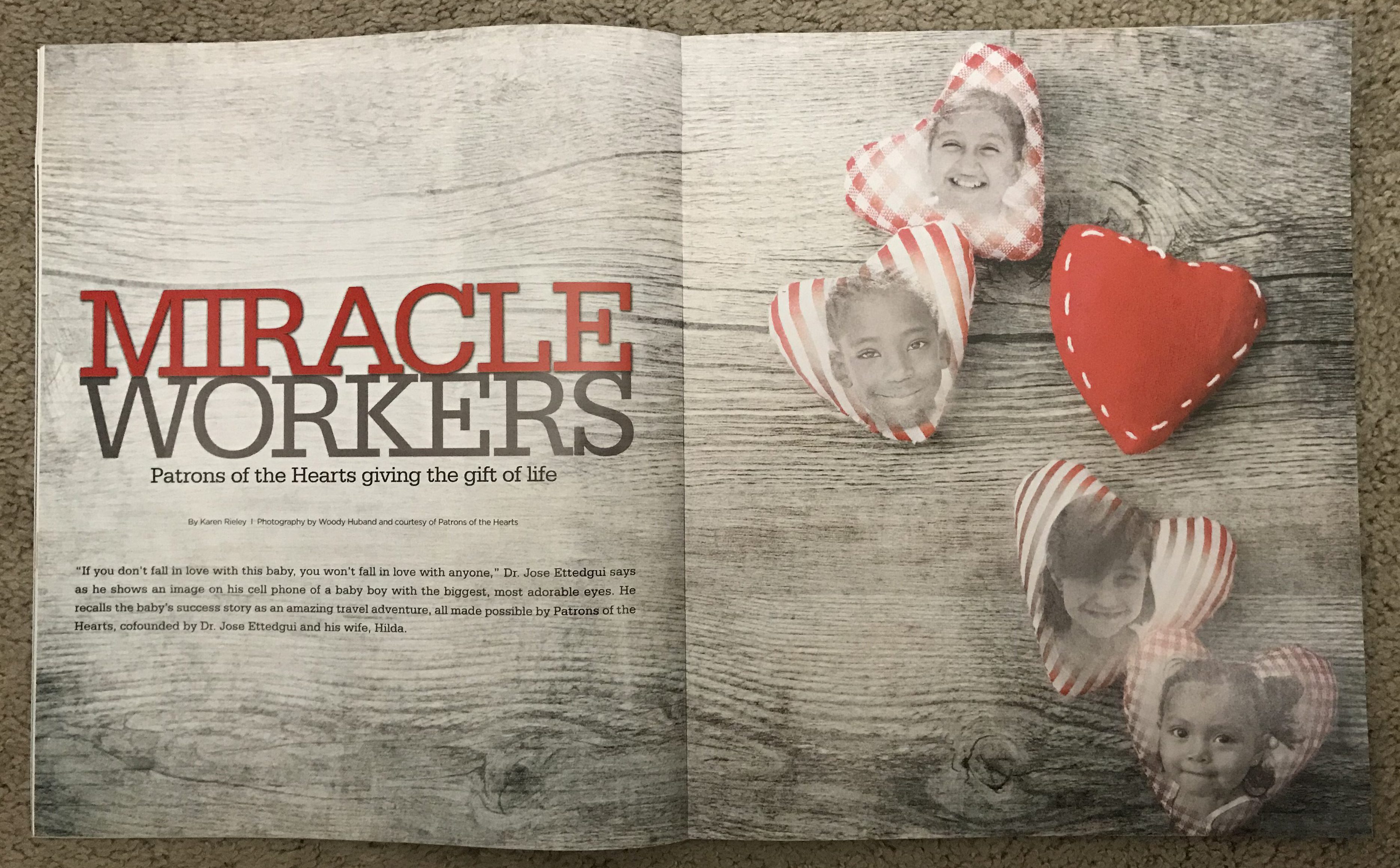
Miracle Workers: Patrons of the Hearts Giving the Gift of Life

ettedgui-familyMy fifth story appeared in the “High Tide Features” section of First Coast Magazine and was the longest one I’ve been asked to write for the magazine to date. It was very special to write, because the Ettedjuis are such a wonderful couple – they have had the means, influence, talent and passion to help so many children with heart defects from around the world. I hope you take the time to read about this special couple and their wonderful organization, Patrons of the Hearts.

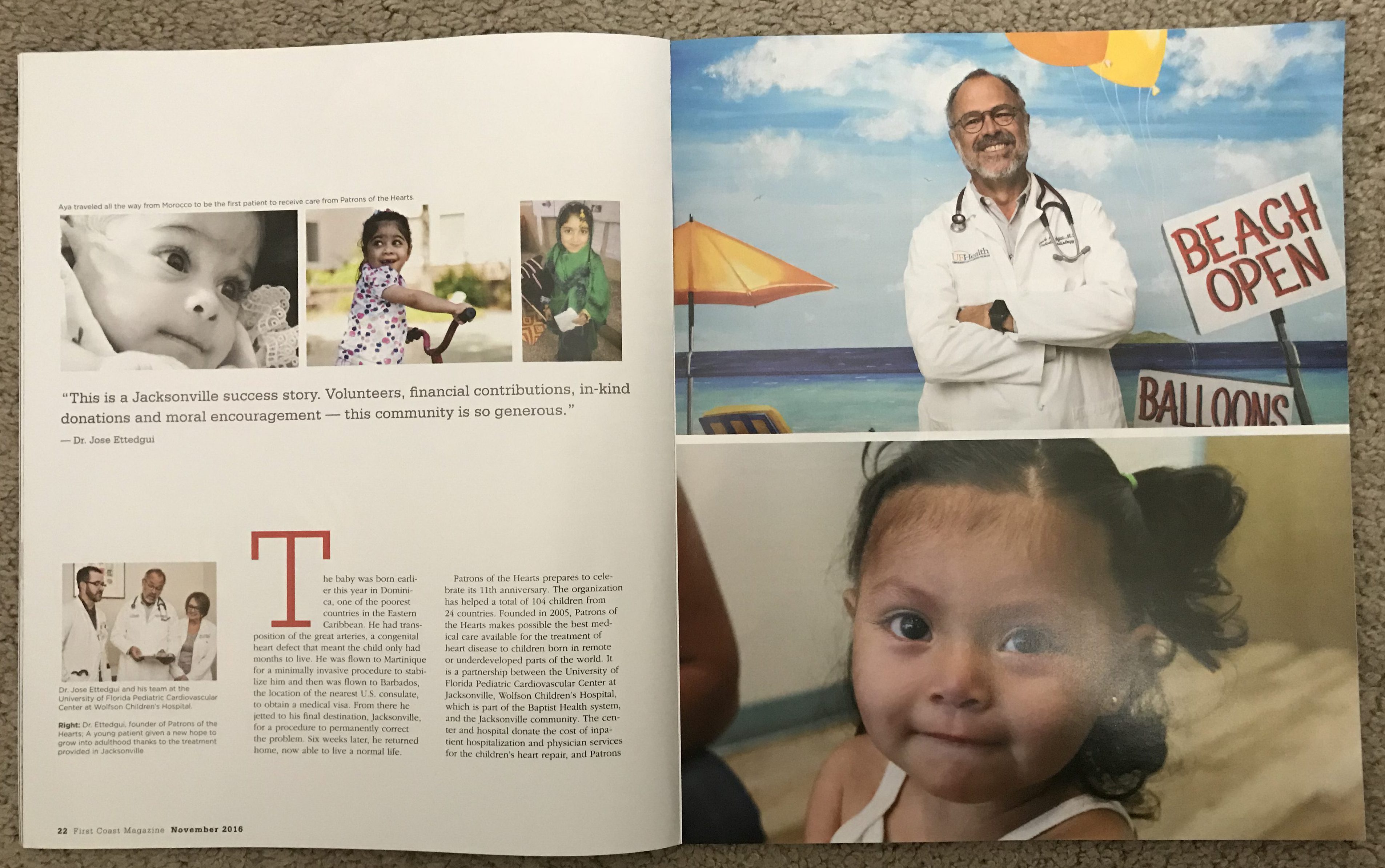
The baby was born earlier this year in Dominica, one of the poorest countries in the Eastern Caribbean. He had transposition of the great arteries, a congenital heart defect that meant the child only had months to live. He was flown to Martinique for a minimally invasive procedure to stabilize him and then was flown to Barbados, the location of the nearest U.S. consulate, to obtain a medical visa. From there he jetted to his final destination, Jacksonville, for a procedure to permanently correct the problem. Six weeks later, he returned home, now able to live a normal life.

Patrons of the Hearts prepares to celebrate its 11th anniversary. The organization has helped a total of 104 children from 24 countries. Founded in 2005, Patrons of the Hearts makes possible the best medical care available for the treatment of heart disease to children born in remote or underdeveloped parts of the world. It is a partnership between the University of Florida Pediatric Cardiovascular Center at Jacksonville, Wolfs Children’s Hospital, which is part of the Baptist Health system and the Jacksonville community. The center and hospital donate the cost of inpatient hospitalization and physician services for the children’s heart repair, and Patrons of the Hearts covers the supplies, housing and incidentals for each child, an average of $5,000 per child. The physicians and nurses and other medical staff donate their services as well.

“It has been an extraordinary 10 years,” Jose says. “From the first year, 2006, when our hope was to bring in one or two children and we actually brought six, to now, when we’re averaging 10 to 12 a year, it has been a beautiful experience.”

The Ettedguis moved to Jacksonville in 2002. The next year Jose went on a mission trip to Kenya. The medical team hoped to put their expertise to good use in treating children with heart problems.

“The outcome was not as good as we wanted,” he says. “We found that trying to deliver very complex, sophisticated care in an environment that had little to no infrastructure to support our work meant that the children didn’t fare well after surgery. We knew that the children would have done better here, so we changed model.

Jose remembers the first baby they brought as the most challenging case. Aya was six months old and from Morocco. She had an initial operation for chronic heart failure, from which she recovered well. As planned, Aya had a second operation two-and-a-half years later. Afterwards, she became very sick and nearly died. She slowly recovered, however, and a few years after that, she had a third and final procedure. Jose reports that she is 11 now and doing very well.

The Ettedguis are quick to give credit to the whole community. “This is a Jacksonville success story. Volunteers, financial contribution, in-kind donations and moral encouragement – this community is so generous,” he says.

Hilda Ettedgui is the creator of Artscapade, an annual event that raises the funds needed to bring the children to Jacksonville and treat them. “We focus on the children we’ve been able to help and on raising awareness of how many more need our help. We call it a celebration, where art, music, fun and the love for children meet,’ she says.

The local arts community is a major participant in the event, donating art that is exhibited ahead of the event and then auctioned off to attendees. “We always have children’s art as part of the event as well,” Jose says. A variety of art, such as a choir or professional dancers, have also been part of this special event.”

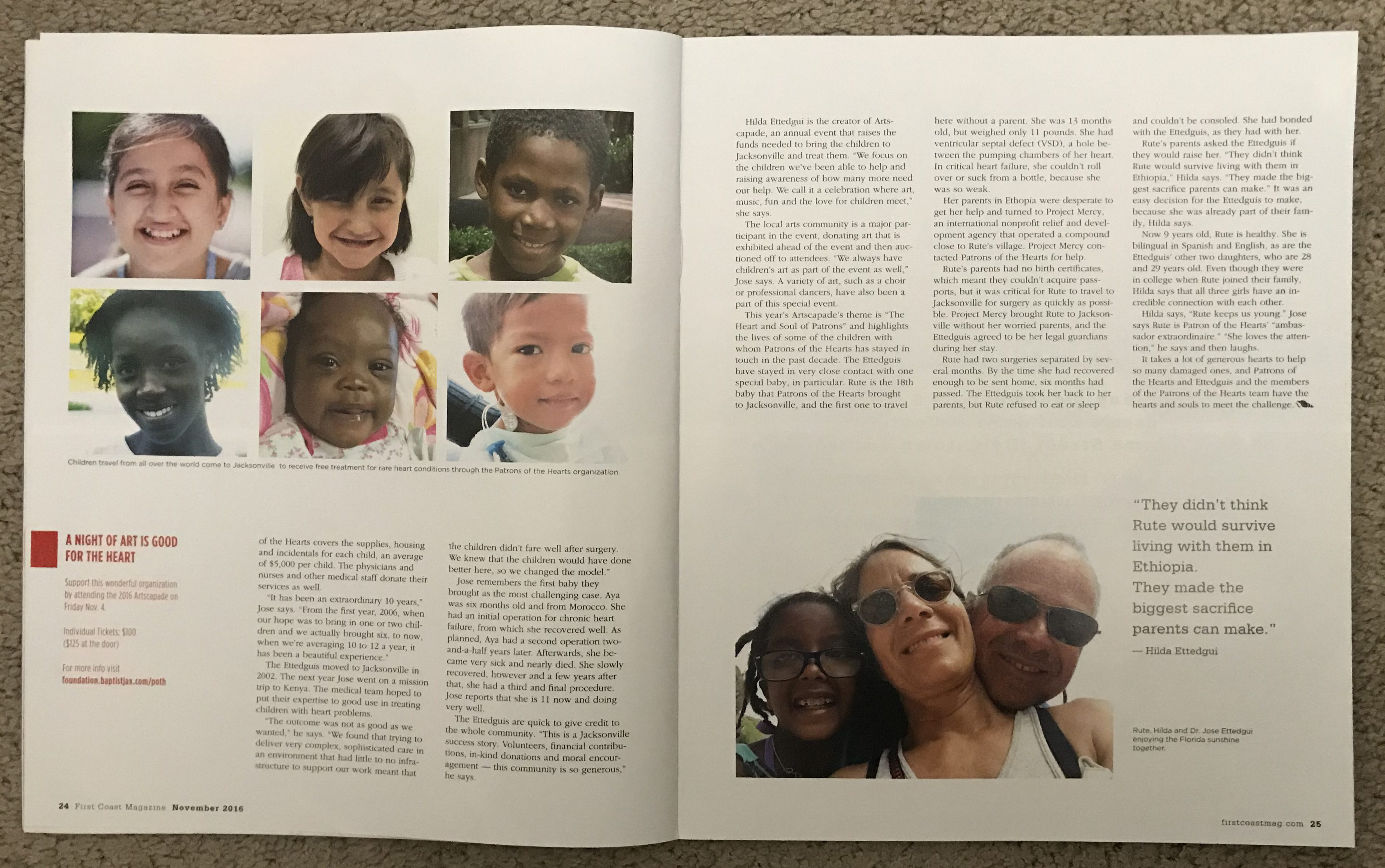
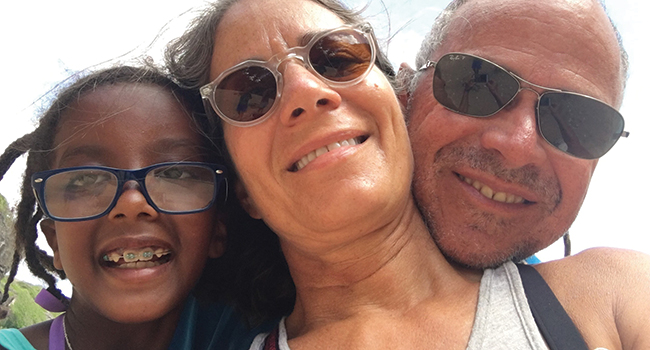
This year’s Artscapade’s theme is “The Heart and Soul of Patrons” and highlights the lives of some of the children with whom Patrons of the Hearts has stayed in touch in the past decade. The Ettedguis have stayed in very close contact with one special baby, in particular. Rute is the 18th baby that Patrons of the Hearts brought to Jacksonville and the first one to travel here without a parent. She was 13 months old but weighed only 11 pounds. She had ventricular septal defect (VSD), a hole between the pumping chambers of her heart. In critical heart failure, she couldn’t roll over or suck from a bottle, because she was so weak.

Her parents in Ethiopia were desperate to get her help and turned to Project Mercy, an international nonprofit relief and development agency that operated a compound close to Rute’s village. Project Mercy contacted Patrons of the Hearts for help.

Rute’s parents had no birth certificates, which meant they couldn’t acquire passports, but it was critical for Rute to travel to Jacksonville for surgery as quickly as possible. Project Mercy brought Rute to Jacksonville without her worried parents, and the Ettedguis agreed to be her legal guardians during her stay.

Rute had two surgeries separated by several months. By the time she had recovered enough to be sent home, six months has passed. The Ettedguis took her back to her parents, but Rute refused to eat or sleep and couldn’t be consoled. She had bonded with the Ettedguis, as they had with her.

Rute’s parents asked the Ettedguis if they would raise her. “They didn’t think Rute would survive living with them in Ethiopia,” Hilda says. “They made the biggest sacrifice parents can make.” It was an easy decision for the Ettedguis to make, because she was already part of their family, Hilda says.

Now 9 years old, Rute is healthy. She is bilingual in Spanish and English, as are the Ettedguis’ other two daughters, who are 28 and 29 years old. Even though they were in college when Rute joined their family, Hilda says that all three girls have an incredible connection with each other.

Hilda says, “Rute keeps us young,” Jose says Rute is Patron of the Hearts’ “ambassador extraordinaire,”

“She loves the attention,” he says and then laughs.

It takes a lot of generous hearts to help so many damaged ones, and Patrons of the Hearts and Ettedguis and the members of the Patrons of the Hearts team have the hearts and souls to meet the challenge.

Tradition is in Full Bloom at Kuhn Flowers

kuhnMy article #4 for First Coast Magazine appeared in its February 2016 issue. I was asked to write about a Jacksonville institution – Kuhn Flowers. The floral shop was long-established before I moved to Jacksonville in 1978, and its history is one of a true love story, most fitting for the month of roses, sweet nothings and romance. Read more here.

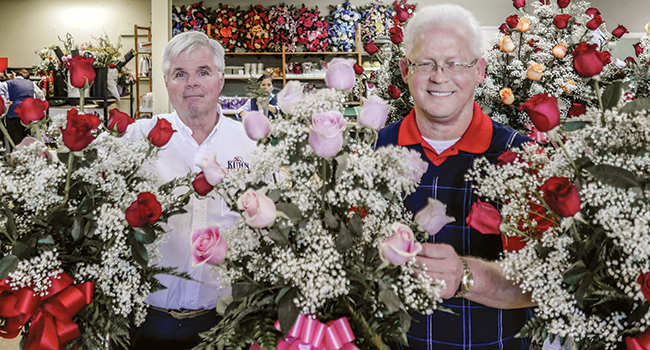
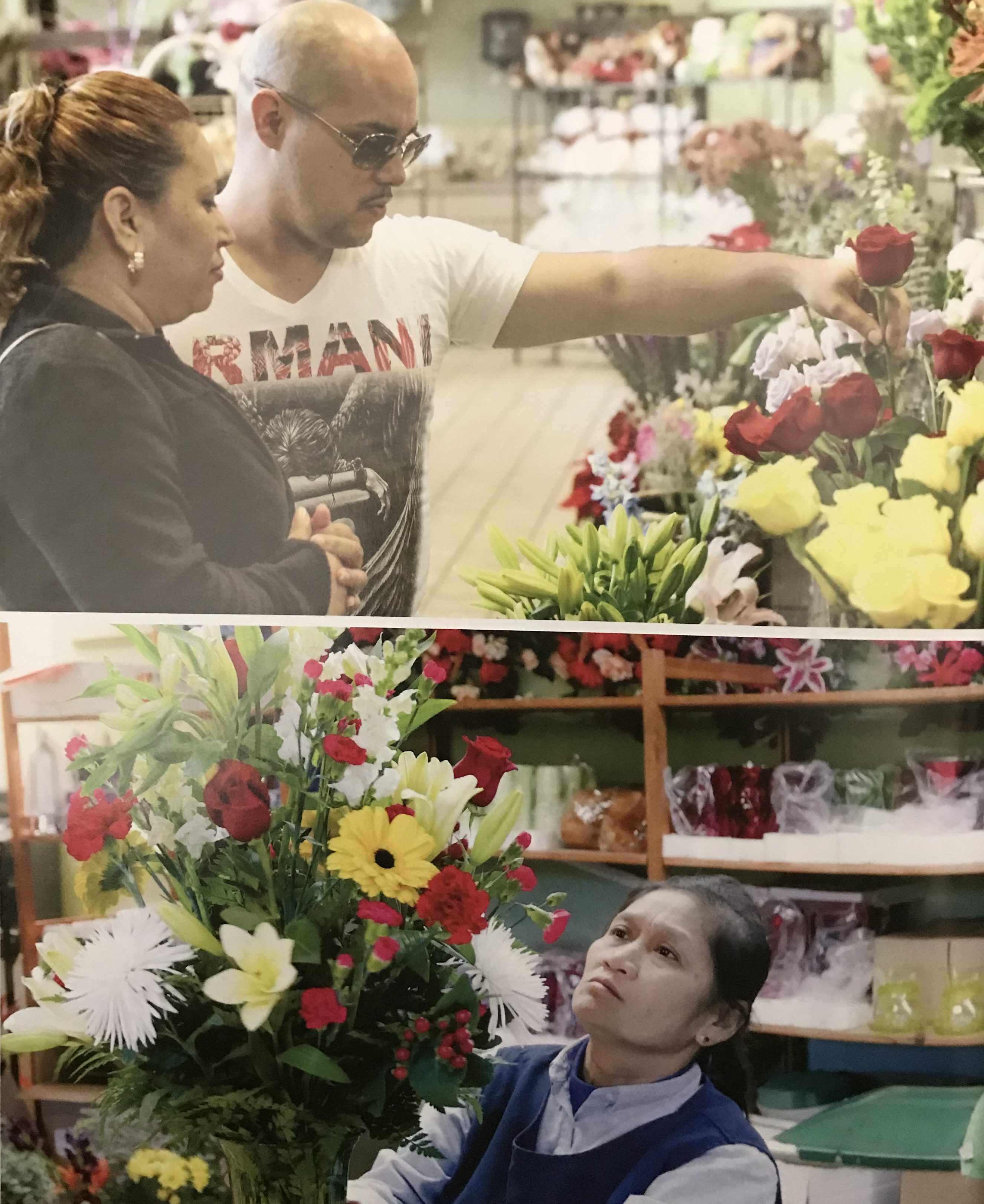
Valentine’s Day is Kuhn’s largest volume day, with more than 2,000 deliveries out of the Beach store alone. That requires 150 delivery people and 150 delivery vehicles. The store’s large volume allows it to buy flowers directly from growers, not via wholesalers, from around the world.

Kuhn Flowers was built with love. Nancy was the floral designer, and Bob Kuhn marketed and managed the business. Bob had worked in greenhouses as a kid, so opening Kuhn Flowers was a natural next set for him. Nancy and Bob married, and Kuhn Flowers became their life. It was the only business they ever owned. Bob bought up a number of smaller floral shops and rolled them into Kuhn Flowers after he relocated to Beach Boulevard in 1958. The Ponte Vedra Beach store is Kuhn’s only branch. “They both worked every day until they were about 70,” Howard says. They retired in 1984.

While no Kuhn family member is still a part of the business, traditions started by Nancy and Bob Kuhn 68 years ago, in the store’s first location in downtown Jacksonville, are still kept alive today. The seasonal celebration in Kuhn Flowers’ two-story storefront window is a Jacksonville destination, not just for locals, but regionally as well. Christmas decorations are up by Nov. 1 and stay up for 60 days.

“It used to be a tradition for many families to have Thanksgiving dinner and then pile everyone in the car to come see our Christmas window,” Howard says. McCall has revived the Kuhn window tradition for holidays. Santa has visited the store for the past seven years for children to have photos taken. “We hope to have the Easter Bunny visit as well,” McCall says. And, at Halloween, the employees dress up in costumes. And of course, there is a rose in every arrangement that leaves the store on Valentine’s Day. Both McCall and Howard buy their daughters flowers every Valentine’s Day. They do this to set an example for them, illustrating how women should be celebrated by the men in their lives.

“My best advice to a guy is to start now developing a personal relationship with a floral shop that delivers,” McCall says. “Then, the week before Valentine’s Day, he can call the store to have flowers delivered to his girl on Wednesday or Thursday before Sunday’s Valentine’s Day. This gives her plenty of time to show off to her girlfriends how much she is loved.”