The Way We Were: William H. Rose

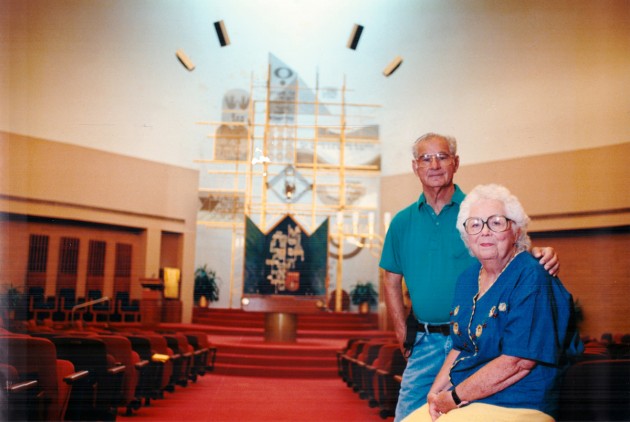
William and Betty Rose
KAREN RIELEY
PUBLISHED IN MARCH 2019 ISSUE OF THE RESIDENT NEWS –https://residentnews.net/2018/08/02/way-we-were-william-h-rose

William Rose has a lifetime of memories and a postcard art collection that allows him to see Jacksonville through the eyes of his father, Max Rose, as well as recall his younger years growing up in Jacksonville.

Rose, 92, has collected postcards produced in the early 1900s of Springfield and downtown Jacksonville that he has enlarged and framed. Some of the postcards were ones his father bought in 1918 and wrote to mail to his mother, Bessie, who was living in Baltimore before his parents married. He also buys postcards of old scenes in Jacksonville.
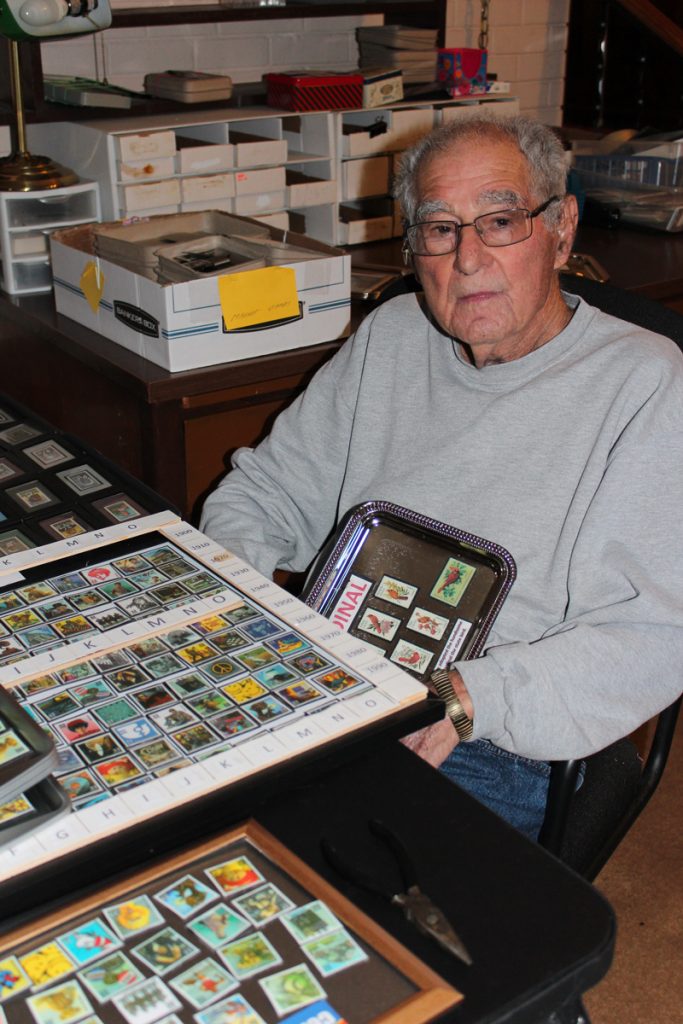
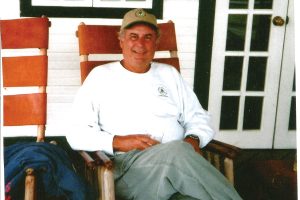
William Rose with stamp collection

He collects postage stamps, too. He remembers digging for stamps in the dumpsters behind the downtown U.S. Post Office building.

Rose’s father was born in Lithuania. His grandfather moved to South Africa to avoid serving in the military, and his father went to live with him when he was 13 years old. Rose’s father and grandfather moved to Jacksonville in 1911 so that his father’s aunt, Ida Feldman, could help raise his father.

“My aunt was extremely wealthy,” Rose said. “In the 1900s, she and her husband, Morris Feldman, owned a lot of downtown Jacksonville property on Bay Street.”

When the aunt died, she left the house that used to be at Post and King in Riverside to Rose’s father. She left the rest of her money to River Garden Nursing Home, Jacksonville Jewish Center and the country of Palestine.
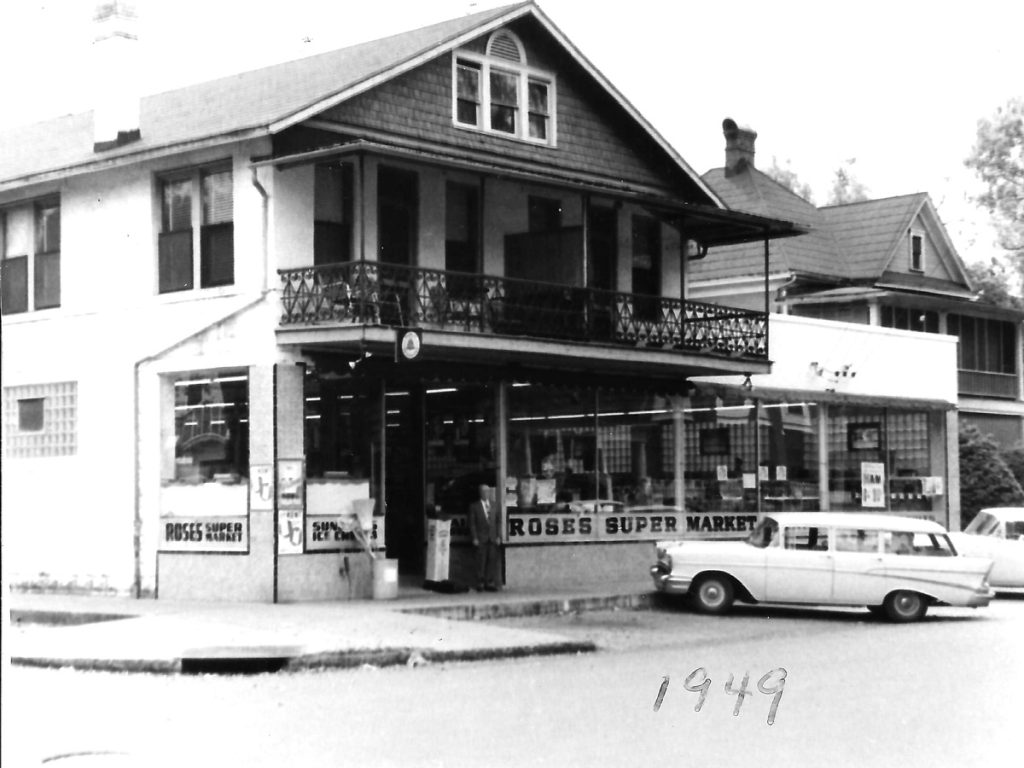
His dad's store, Rose's Super Market, at 6th & Market
His dad’s store, Rose’s Super Market, at 6th & Market

In January 1917, Rose’s father married Bessie Isaacs. In 1919, he opened a grocery store in Springfield at 6th and Market. A Feb. 2, 1935 ad for Rose’s Grocery & Meat Market, at the corner of Sixth and Market streets listed meat prices of 20 cents per pound for homemade pan pork sausage, 15 cents per pound for rump or chuck beef roast and three cans of dog food for 25 cents.

“My father would try to talk guys out of buying cigarettes by telling them that they weren’t good for them,” he said. “He told them that they weren’t made for smoking; they were made for selling.”

William’s father, Max Rose, operated the grocery and meat market for 50 years. In a story that appeared in the Oct. 23, 1972 edition of the Jacksonville Journal, Rose’s father, who was then 81, recalled the early days of operating the store. “In those days you knew everyone, and everyone was your friend,” he said.

Rose’s father had a delivery service as well. “I’d pedal over on a special bicycle with a big basket up front. People would call up for kerosene, and I’d go over, pick up their empty 5-gallon can, fill it and ride back to their house. I made a 10-cent profit on the deal.”

When William was born in 1926, his family lived in the house behind the grocery store. Rose had two older sisters, Mildred Rose Rothstein and Charlotte Rose Fialkow.
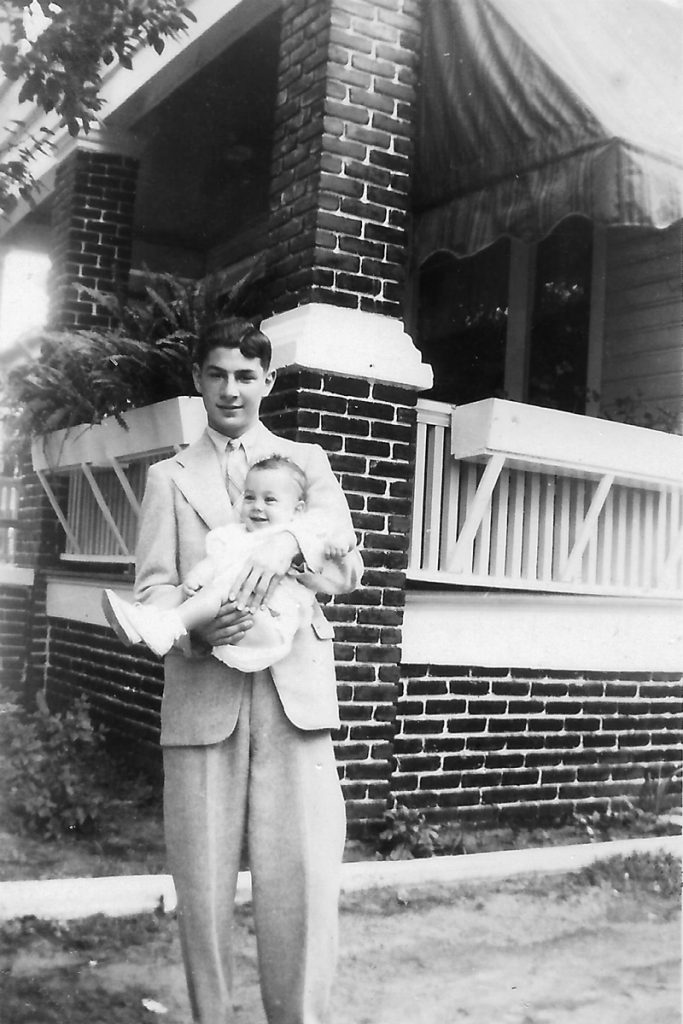
Uncle William holding niece Barbara in 1939 at the family home on 6th Street

“They tell me that my father was so happy to have a son that he added “and Son” to the “Rose’s Grocery Store sign when I was born,” Rose said. “But he took that off before I was old enough to notice it.”

Rose remembers that the streetcar in Springfield used to cost a nickel for one ticket or a dime for three tickets. Cabs cost 10 cents to ride, but they didn’t go everywhere. He had a girlfriend who attended Lee High School. After he finished a school day at Andrew Jackson High School, he would pay 10 cents to take a cab to downtown Jacksonville, and then he had to pay another 10 cents to take a different cab to Lee High School in Riverside.

Rose claims to have visited all of the movie theaters in downtown Jacksonville as well as the Riverside Theater, now called Sun-Ray Cinema, in 5 Points. That theater opened in 1927 and was the first theater in Florida equipped to show talking pictures and had air conditioning.

“I went to many movies at The Florida Theatre,” he said. “I remember Jimmy Knight playing the Mighty Wurlitzer organ in the mid- to late-1930s. The Florida Theatre, built in 1927, was the largest movie palace in Jacksonville and one of only four remaining grand movie palaces of the era in the state.

“I also remember going to the Capitol Theatre on Main Street between 7th and 8th Streets,” Rose said. “My father would give me a dime for the movie and a penny for the gum-ball machine.”

One Saturday in 1934 or 1935, when Rose was eight or nine, he went to the theatre to see what he recalls as “Little Orphan Annie.” When he finally got to the front of the line, he placed a coin on the counter. The cashier said, “Son, the movie is a dime, and this is a penny.” He suddenly realized that he must have put the dime in the gum-ball machine by mistake. “I never did see the movie,” he said.

Rose’s father bought a Pontiac in 1937 from Claude Nolan. “It cost more than $900. I couldn’t believe that it had a radio in it,” he said.

Rose worked for his father in the grocery store until he finished high school and enlisted in the Navy during World War II. He was on the USS Alex Diachenko, which was assigned to the Asiatic-Pacific Theater and participated as a transport ship in the consolidation and capture of the Southern Philippines and Borneo operations.
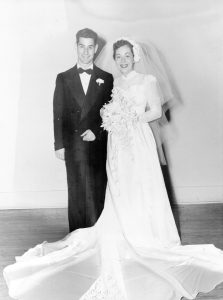
William and Betty Rose, 1951

When Rose came back to Jacksonville after service, he lived with his parents for a couple of years until he married Betty Sager in 1951, also a lifelong resident of Jacksonville. She had graduated from Lee High School and Florida State College for Women (FSU).

With his new bride, Rose bought the house he lives in now on San Amaro Road for $17,000. “People wondered why we wanted to live so far out of town,” he recalled.

He used to walk down the middle of San Jose Boulevard because there was so little traffic. “I remember cars hitting the telephone poles because the kerosene street lamps would go out and they couldn’t see the poles in time,” Rose said. “I used my flashlight to help direct traffic.”

He was working at his father’s grocery store in Springfield when he got married, and his daily commute required traveling from Miramar to Springfield every day.

“I’d buy turnip greens from the produce market, take them home, put them in the yard and sprinkle water on them to keep them fresh,” Rose said. “The next day I’d put them back in my car and take them to the grocery store.”

On Dec. 29, 1963, Rose was on his way to work when he saw smoke coming out of all the windows of the Hotel Roosevelt in downtown Jacksonville. Fire had broken out in the ballroom of the 13-story hotel, one of Jacksonville’s most grand hotels, on Adams Street just west of Main. Twenty-two people died, most from asphyxiation and carbon-monoxide poisoning. Some people escaped to the roof and needed help. Rose told the rescue people to call the Navy to get the people off the roof. “The next day I read in the paper that the mayor had called the Navy,” Rose laughed. “But I think they got the idea from me.”
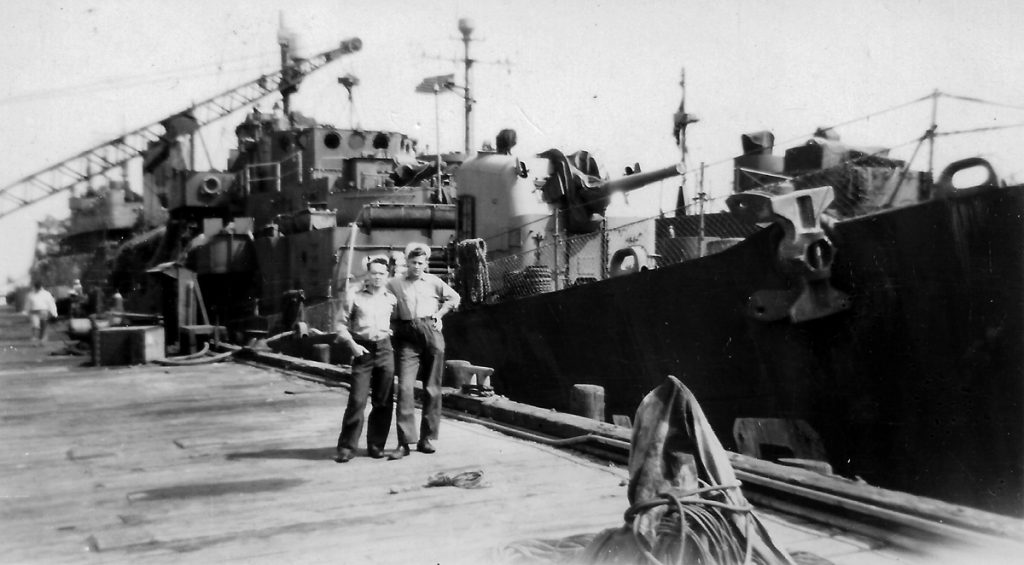
Rose in the Navy assigned to the USS Alex Diachenko transport ship

When his father became too old to run the grocery store, Rose sold it. His father told him to go see Benjamin Setzer at National Drug Company, who asked him to come to work for him to oversee distribution. Setzer, a Lithuanian immigrant like his father and a former Springfield resident, had operated Setzer’s Supermarkets that became one of Jacksonville’s early grocery chains by the end of the Great Depression.

Then Rose worked for his brother-in-law’s wholesale grocery, the Hymie Fialkow Company. His brother-in-law eventually sold his grocery to Sysco Corp., where Rose worked as senior marketing associate until his retirement 17 years later.

After he retired, he volunteered in gift shops. He noticed framed stamps that were selling for $25; the stamp was worth 25 cents. He thought would be a good way to get rid of his stamps at flea markets. He also makes kitchen magnets out of postage stamps and has earned the moniker of “The Stamp Man.”

After 30 years of service in the Department of Children & Families, Betty retired and devoted many hours volunteering for her synagogue, the Jacksonville Jewish Center, Hospice and Bikkur Cholim. The couple were married for 57 years before Betty passed away in 2008 and had two daughters, Margaret Rose and Allison Rose Holtz.

Both Betty and William were active in the Jacksonville Jewish Center and the center’s synagogue for many years. Betty volunteered in the office and William made sure the right prayer books were in every one of the 375 seats.

Age has caught up with Rose leading him to decide to quit driving, which means he won’t be going to the flea market any longer. But, he still intends on continuing to frame stamps. “It keeps me busy and I love doing it,” he said.
The Way We Were: Dr. Maria Acosta-Rua

BY KAREN RIELEY
PUBLISHED IN JANUARY 2018 ISSUE OF THE RESIDENT NEWS – http://residentnews.net/2017/12/05/youth-learns-lessons-homelessness-7th-annual-cardboard-city/

Dr. Maria Acosta-Rua and her late husband, Dr. Gaston Acosta-Rua, have never forgotten their past even as they contributed so much to their Jacksonville community. Theirs is truly an international tale, in which they have intertwined their Spanish and American lives to the benefit of both.

AcostaRua_01-200x300
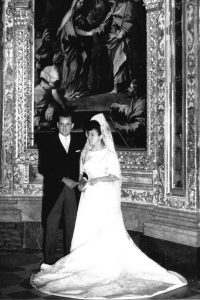
Acosta-Rua wedding in front of “The Marriage of the Virgin Mary and St. Joseph” in the Monastery of Guadeloupe

As soon as they graduated, he moved to Miami to work hard, save money and take his Educational Council for Foreign Medical Graduates (ECFMG) exam, but he promised he would come back for her in Madrid in a year. He kept his promise, and they were married two weeks later in the Monastery of Guadeloupe, because he had to start an internship in Cleveland very soon.Gaston Acosta-Rua and Maria Victoria Pol Gimenez met in Madrid in their last year of medical school. Gaston was a counter-revolutionary who escaped from Cuba, and Maria was from Madrid.

Maria found herself in a new country, with a new husband who worked rotation in the hospital every other night, in what seemed to her to be gloomy Cleveland compared to Madrid, where she remembers people always out in the streets visiting with each other. She became pregnant almost immediately so that meant she would soon be a new mother in addition to being a young wife.

“It was a real cultural shock for me, and I felt very lonely and depressed,” Maria said. But, once Gaston Jr. was born, she had someone to care for and occupy her time. She began to meet people in the neighborhood when she took baby Gaston out for walks.

As she gradually adjusted to her new life, she started thinking about her own career and studying to take ECFMG exam herself.

“It was not an easy task,” Maria said. “The exam was in English and included subjects from all of the medical school courses, which I had studied in Spanish.” But she persevered and became a “real” doctor.

In 1967, Gaston moved to Iowa City to start his neurosurgical residency. Maria and Gaston Jr. stayed in Cleveland until she completed her internship the following June.

AcostaRua_04-200x300
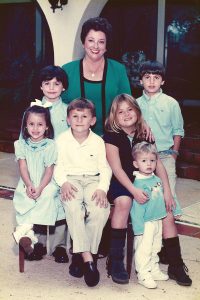
Maria Acosta-Rua with her grandchildren: Somerset (seated), Alex and Daría (in the front), Andrew (standing), Mills and Fernando Jr. (back), circa 2005

Gaston Jr. now lives in Connecticut with his wife, Lianne. Fernando was born soon after they moved to Iowa and right before Maria began her child psychiatry training. He lives in Jacksonville and is the CEO of Pet Paradise. Tony, who was born when Maria was mid-way through child psychiatry training, lives in Costa Rica with his wife, Adriana. Maria now has six grandchildren – three each by Gaston Jr. and Fernando.

After completing their training, they wanted to move to Florida. Like most Cubans, Gaston hoped he could return to Cuba someday and Florida was as close as he could get us to Cuba,” Maria said.

They thought they would move to Miami, but Gaston’s chief resident in Iowa, Dr. Tom Boulter, who was by then practicing in Jacksonville, found him a position with Lyerly Neurosurgery in Riverside.

The doctor rented a house for them on Ortega Boulevard, and they ended up liking the neighborhood so much that after two years they bought a house on Long Bow Road, where they lived from 1975 to 1981. Next, they moved to Ortega Forest, where Maria still lives.

After moving to Jacksonville, Maria was determined to put her education to work. In 1973, she started her child psychiatry practice on Oak Street in Riverside.

She was a pioneer as the very first child psychiatrist in Jacksonville. She worked the longest with children at Daniel Kids and has also worked with many other nonprofits that provide services to children, for example, Youth Crisis Center, Florida Baptist Children’s Homes, Child Guidance Center, Children’s Home Society, the Florida School for the Deaf & Blind, Jacksonville Youth Sanctuary, Northeast Florida State Hospital and Boys Home Association of Jacksonville, in addition to her own private practice. For the last 15 years of her career, Maria worked with foster children.

“I started the first day treatment facility for emotionally disturbed children with St. Vincent’s and the school system, and then I started a children’s psychiatric ward with Baptist,” said Maria, who retired three years ago.

AcostaRua_02-300x200
Gaston Acosta-Rua relaxing on the porch of his Costa Rican farm

Maria shares Gaston’s story of escaping from Cuba. “He was 21 years old and working underground against Castro,” she said. “The government was looking for him to put him in prison.”Maria is very proud of the work her husband did, not only in Jacksonville, but in Mexico, Costa Rica and Africa as well. “Gaston was an excellent neurosurgeon and worked in every hospital in Jacksonville,” she said. “He did missionary work for more than 20 years. Going with a Mercy Ship to Africa in 1995 was the highlight of his life.”

He was introduced by his mother to Fidel Castro’s sister, who was anti-Communist. She arranged for Gaston to get on a plane out of Cuba, rather than having to escape by boat. After a brief stay in Costa Rica, Gaston eventually traveled to Miami.

Gaston returned to Cuba only once in 1998. He traveled with a Catholic organization called the Order of Malta to bring wheelchairs to Daughters of Charity for the home they were running for severely handicapped children and adults.

The Acosta-Ruas have contributed much to Jacksonville’s medical sector. “Even now, when I sign something people often recognize the last name and remember that one of us helped them,” Maria said.

Gaston kept feeling drawn to help people in Costa Rica, so much so that he bought a farm there. He helped with medical and social contributions.

In 2002, Gaston was diagnosed with pancreatic cancer. As physicians, Maria and he both knew that this meant the end. “He was never in hospice,” Maria said. “Gaston knew what was coming and was determined to live each day to the fullest.”

He went back to work, played tennis and decided to write about his childhood and his experiences in Cuba, his escape and his memories of life for his children and grandchildren. He also established the Acosta-Rua Family Foundation, with the mission to relive the burden of the poor and the sick, both locally and in Latin America.

AcostaRua_05-300x200
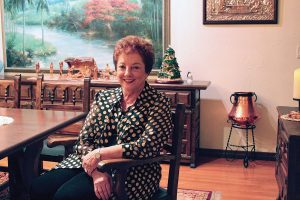
Maria Acosta-Rua relaxes at home in Ortega Forest.

Gaston passed away seven months after he was diagnosed. After his death, their son, Fernando, became involved with Community Hospice & Palliative Care. He is presently the chairman of organization’s Board of Directors and a member of its foundation. The Acosta-Rua family made a naming gift for a new 16-bed center called “The Dr. Gaston J. Acosta-Rua Center for Caring” in Gaston’s memory.

Fernando and his wife, Brooke, have held seven fundraising events called “A Sunset in Costa Rica” to benefit both the Children’s Hospice in Costa Rica, and Community PedsCare (pediatric hospice and palliative care) in Jacksonville. When a second hospice was built recently in Costa Rica, it was named “Doctor Gaston Acosta-Rua Center.”

At the time of this interview, Maria and various other friends and workers were busily preparing for the Acosta-Rua family’s annual celebration of Gaston’s escape from Cuba. They used to hold the event on the actual date of his escape, Dec. 28, but now they hold it earlier in the month when it is most convenient. Fernando and Tony roast a whole pig outside. Maria prepares black beans, rice and salad for more than 100 people.

When Maria and Gaston first moved to Ortega Forest, mostly Cuban friends attended, but now friends of their children and their families are the majority of those attending. Many of them are Bolles alumni because all three sons played football for and graduated from the private school in the San Jose area on the St. Johns River. Tony also played Bolles baseball. Fernando is currently a member of Bolles’ Board of Trustees.

The Acosta-Ruas Spanish-style home built in 1981 and Spanish furnishings that they collected from their many trips are the perfect backdrop to the event and reflect their commitment to giving back to help people from the communities of their past and present.

The epigraph in Acosta-Rua … Las Memorias, written by Gaston and Maria Acosta-Rua with Susan D. Brandenburg, exemplifies the Acosta-Ruas’ lives: “To be ignorant of what occurred before you were born is to remain always a child for what is the worth of human life unless it is woven into the lives of our ancestors by the record of history.” (Cicero 106 BC)

Day Tripping in Palatka – The Gem of the St. Johns

Back in our early days living in Florida, my husband and I took a few big trips but, more often, enjoyed spontaneously leaving town for the weekend – even just a two-day weekend. We tried out a number of bed-and-breakfast inns in St. Augustine, Cedar Key and Micanopy, Florida, and Americus and Brunswick, Georgia, for example. We enjoyed exploring these towns specifically because they held true to their origins, the real land and people, rather than the illusions of opulence, sensory experiences and never ending excitement that developers have created – the elite, exclusive coastal resorts; the sights, sounds and libations of nightclubs; and the illusions of the many entertainment parks. Admittedly, we have partaken of all those experiences, too, but my best memories of Florida are the authentic ones.

We let this Fourth of July sneak up on us. I turned my focus from crazy-busy work stuff long enough to ask for July 3 off, but never got around to planning anything for us to do. This past Wednesday, I looked up from my computer and realized that I needed to come up with something or else we would just sit around wasting four perfectly good days better spent enjoying being with each other and experiencing something other than the stress of work obligations.

It was probably too late to try to make overnight plans, plus I wasn’t sure that I wanted to go to the trouble of packing, driving many miles and then adjusting to a hotel room (all activities that become less and less appealing the older I get, I confess). So, I recalled our fun, spontaneous weekend trips and googled “places to visit in northeast Florida.” The Northeast Florida Backroads Travel Guide website came up near the top of the list and sounded intriguing, so I decided to check it for day trips. Of the nine northeast Florida towns listed, Crescent City and Palatka were the two of which I was the least familiar. I don’t think I’ve ever visited Crescent City, so that’s a trip for another day perhaps.

Palatka is one of those small Florida cities that I’ve driven through many times without stopping and barely even noticed except for the speed limit signs which are notoriously important to observe, as small-town cops use ticketing to acquire much-needed town revenue. It is nestled in a bend on the St. Johns  River and was a major port for many years because initially it was the southernmost port for transporting trade items and eventually people, as well, until Henry Flagler expanded railroad tracks further south. Once known as “The Gem of the St. Johns River” with hotel accommodations for 6,000, a devastating fire and hard freeze caused a major decline in the area’s visitation and industry.

According to the Putnam Historical Society website, “Palatka” is a contraction of an Indian word meaning “cow crossing” or “cow ford.” The original was some variation of “Pilaklikaha” or “Pilotaikita.” Originally spelled “PIlatka,” the City Charter, approved on January 8, 1853, had the name spelled “PAlatka,” sparking a debate as to the “correct” spelling which would last another twenty-two years until the U.S. Post Office officially changed the spelling to “Palatka” on May 24, 1875, to avoid confusing its name with the town of “Picolata.”

Turns out that the first Sunday each month is a special day in Palatka. Every historical place is open to the public. Among the top 10 places to visit, the Bronson-Mulholland House caught my eye because I love history stories and restoration. I checked out the house’s official website and learned that, while you can drive up to the house and explore the grounds, you can only tour the house on Saturdays, 10 a.m. – 4 p.m., and Sundays, 1-4 p.m. Tours need to be scheduled 72 hours in advance, so that a tour guide can be arranged to take you through the house. I came in just under the wire in making a reservation for 1 p.m., today, Sunday.

We had time to eat brunch before the tour, so I researched good places to eat in Palatka and discovered several. Most feature seafood and fish, which makes perfect sense given Palatka’s location along the St. Johns River – Corky Bell’s Seafood and Musselwhite’s Seafood & Grill received good reviews when I goggled “best places to eat in Palatka, Florida.” Angel’s Diner got good reviews for its hamburgers. But, Magnolia Cafe intrigued me the most, because it seemed to feature a creative brunch menu and had great review comments.

We arrived shortly after the cafe opened at 11 a.m. Located in the middle of downtown Palatka at 705 St. Johns Avenue, the cafe is modestly decorated and has the aura of a comfortable, small-town eatery that everyone knows about, frequents and loves. It is brightly lit mostly by sunlight from the large front windows and the waiters are friendly and attentive. I decided to order the Steak and Egg Benedict with a side salad and my husband ordered the Eggs Florentine Benedict and Cheese Grits. Our eggs benedict were delightful – perfectly puffy poached eggs with beautiful yellow yolks that ran, but didn’t gush, when cut. My husband said his cheese grits were well seasoned and I enjoyed my steak.

I started with a hot cup of coffee and, while my meal was very good, the coffee might have been the star of the meal. Magnolia Cafe is committed to serving organic food, including organic coffee. It serves and sells Sweetwater organic coffee, ground and whole beans, and it is delicious. I was served a tall, narrow mug of steaming coffee with real cream and enjoyed not one, but two, cups. And, I bought one bag each of Dark French Roast from Honduras, Sumatra and Ethiopia and Full City Roast from Peru and Colombia. The coffe is artisan roasted and fairly traded, as a member of the Fair Trade Federation.

After brunch, we had about 45 minutes before our tour started at the Bronson-Mulholland House, so we drove around Palatka checking out the sights. Palatka bills itself as the City of Murals, so the drive was an artistic experience. The Conlee-Snyder Mural Committee is in charge of the larger-than-life murals painted onto the walls of buildings downtown to accurately depict the historical, cultural, and natural riches of Palatka and Putnam County. You can learn about the murals and get a map of their locations on the Conley-Snyder Mural Committee website.

The tour of the Bronson-Mulholland House was free (although donations are much appreciated). Our tour guide was very knowledgeable, interesting, thorough and obviously passionate about sharing history. He took us through the house giving us a history tour of the home’s six eras: Bronson Era, 1854-60; Civil War Era, 1861-65; White Era, 1865-1904; Mulholland Era, 1904-45; Post War Era, 1945-1977; and Restoration Era, 1977-Present. In its early years, the home was the largest in northeast Florida, perhaps even north Florida. It was continuously owned until 1977, when the town government took it over to prevent its further decline and restore it. A government restoration grant helped make the restoration possible. The home has not been restored further since then, and Palatka is seeking another grant to do necessary repairs.

As we prepared to leave Palatka in mid-afternoon, we decided to find Ravine State Gardens and see what was there with the idea that we might want to bookmark it for a return trip in cooler weather. We both grew up in the cool, high mountains of Virginia and the hot, humid Florida summers don’t entice us to take the long walks and hikes that we generally love.

We paid the $5/car admission fee and discovered that a 1.8 mile scenic driveway borders the 70-120 feet deep ravine for which the park is named. In 1933, the ravine was transformed into a dramatic garden by the federal Works Progress Administration. Some of the original landscaping still exists as formal gardens and a unique system of trails. A 64 foot tall obelisk, dedicated to Franklin D Roosevelt, is located near the park entrance. We noted fieldstone terraces, rock gardens, picnic tables including grills, an amphitheater and a suspension bridge, all worthwhile reasons to return again sometime between January and April, peak time for all of the blooming plants and temperate weather, for a picnic and some hiking. Visit http://www.floridastatepark.org for more information.

All in all, it was a perfect Florida day. As we drove back home to Jacksonville, I found myself recalling three of my favorite female Florida authors whose works have captured the real Florida that I love – Marjorie Kinnan Rawlings, Zora Neale Hurston and Connie May Fowler. Another good way to tamp down work stress – read or re-read more by these authors!

Later this evening, my husband and I reflected on how nice the day had been, and he announced that he’d like our next day trip to be a return visit to Micanopy and Cross Creek. We had stayed in the Herlong Mansion many years ago and explored Micanopy but didn’t spend much time in Cross Creek, where Kinnan Rawlings had a homestead in which she lived and wrote. His comment was a perfect ending to the day, as it reminded us that rediscovering places, people and memories can be as exciting as new adventures.

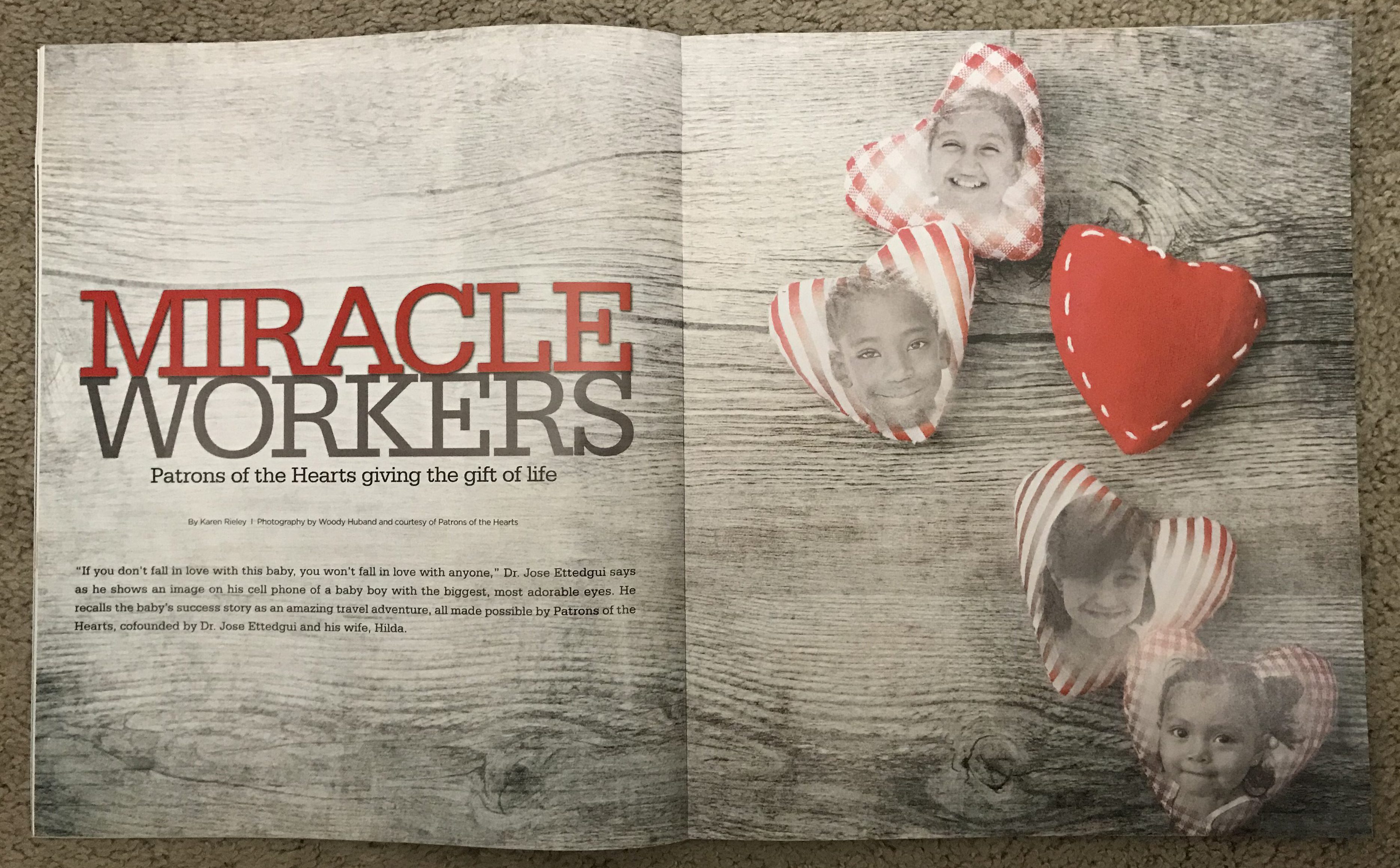
Miracle Workers: Patrons of the Hearts Giving the Gift of Life

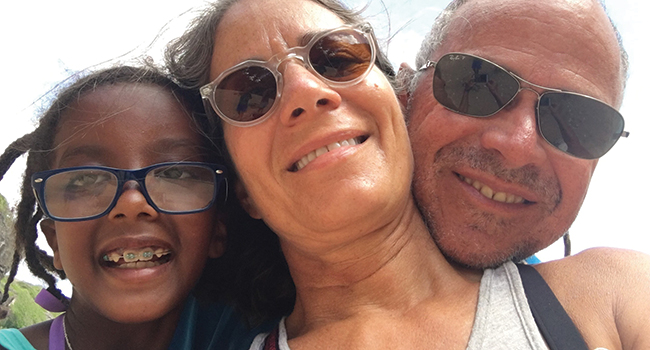
ettedgui-familyMy fifth story appeared in the “High Tide Features” section of First Coast Magazine and was the longest one I’ve been asked to write for the magazine to date. It was very special to write, because the Ettedjuis are such a wonderful couple – they have had the means, influence, talent and passion to help so many children with heart defects from around the world. I hope you take the time to read about this special couple and their wonderful organization, Patrons of the Hearts.

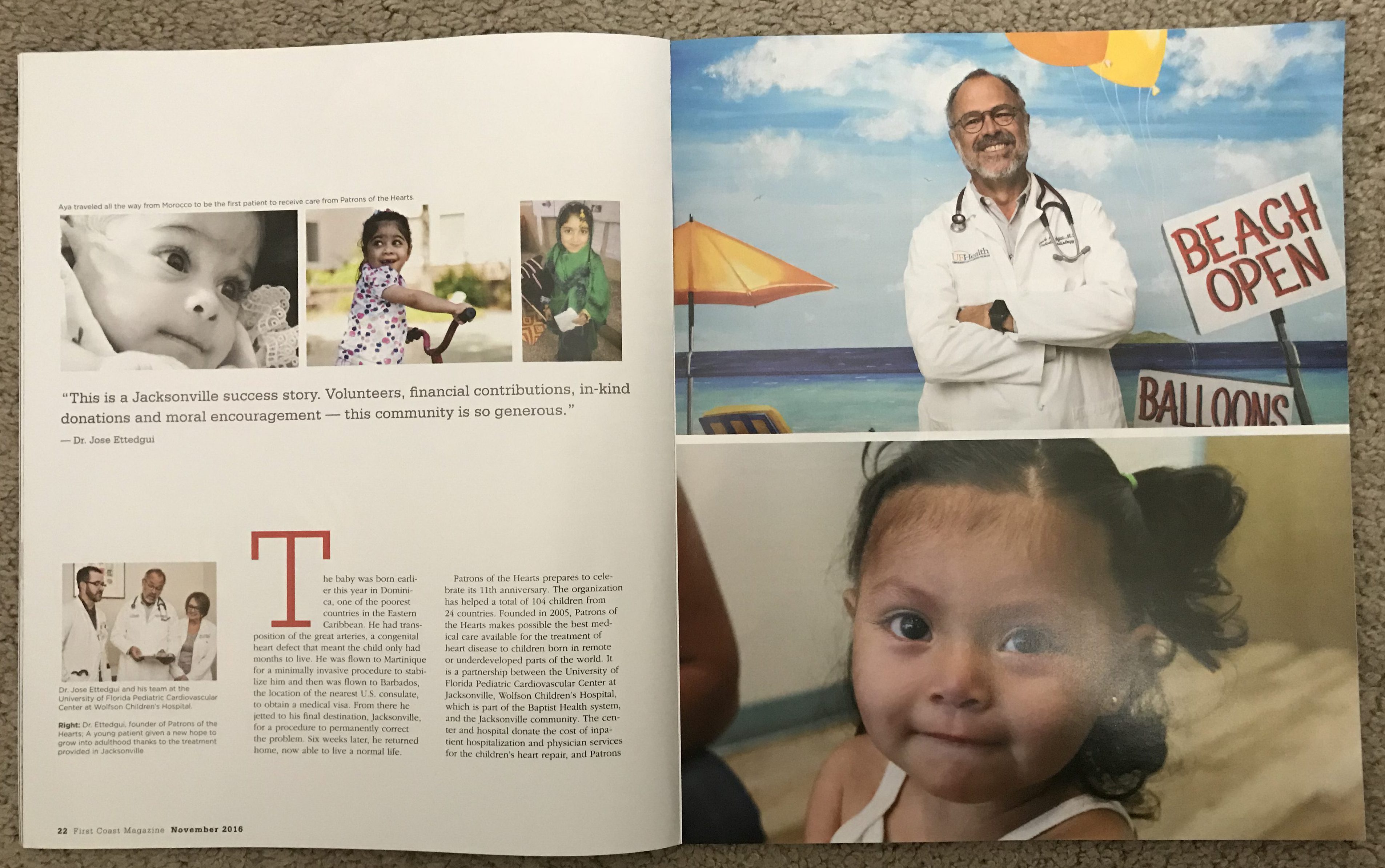
The baby was born earlier this year in Dominica, one of the poorest countries in the Eastern Caribbean. He had transposition of the great arteries, a congenital heart defect that meant the child only had months to live. He was flown to Martinique for a minimally invasive procedure to stabilize him and then was flown to Barbados, the location of the nearest U.S. consulate, to obtain a medical visa. From there he jetted to his final destination, Jacksonville, for a procedure to permanently correct the problem. Six weeks later, he returned home, now able to live a normal life.

Patrons of the Hearts prepares to celebrate its 11th anniversary. The organization has helped a total of 104 children from 24 countries. Founded in 2005, Patrons of the Hearts makes possible the best medical care available for the treatment of heart disease to children born in remote or underdeveloped parts of the world. It is a partnership between the University of Florida Pediatric Cardiovascular Center at Jacksonville, Wolfs Children’s Hospital, which is part of the Baptist Health system and the Jacksonville community. The center and hospital donate the cost of inpatient hospitalization and physician services for the children’s heart repair, and Patrons of the Hearts covers the supplies, housing and incidentals for each child, an average of $5,000 per child. The physicians and nurses and other medical staff donate their services as well.

“It has been an extraordinary 10 years,” Jose says. “From the first year, 2006, when our hope was to bring in one or two children and we actually brought six, to now, when we’re averaging 10 to 12 a year, it has been a beautiful experience.”

The Ettedguis moved to Jacksonville in 2002. The next year Jose went on a mission trip to Kenya. The medical team hoped to put their expertise to good use in treating children with heart problems.

“The outcome was not as good as we wanted,” he says. “We found that trying to deliver very complex, sophisticated care in an environment that had little to no infrastructure to support our work meant that the children didn’t fare well after surgery. We knew that the children would have done better here, so we changed model.

Jose remembers the first baby they brought as the most challenging case. Aya was six months old and from Morocco. She had an initial operation for chronic heart failure, from which she recovered well. As planned, Aya had a second operation two-and-a-half years later. Afterwards, she became very sick and nearly died. She slowly recovered, however, and a few years after that, she had a third and final procedure. Jose reports that she is 11 now and doing very well.

The Ettedguis are quick to give credit to the whole community. “This is a Jacksonville success story. Volunteers, financial contribution, in-kind donations and moral encouragement – this community is so generous,” he says.

Hilda Ettedgui is the creator of Artscapade, an annual event that raises the funds needed to bring the children to Jacksonville and treat them. “We focus on the children we’ve been able to help and on raising awareness of how many more need our help. We call it a celebration, where art, music, fun and the love for children meet,’ she says.

The local arts community is a major participant in the event, donating art that is exhibited ahead of the event and then auctioned off to attendees. “We always have children’s art as part of the event as well,” Jose says. A variety of art, such as a choir or professional dancers, have also been part of this special event.”

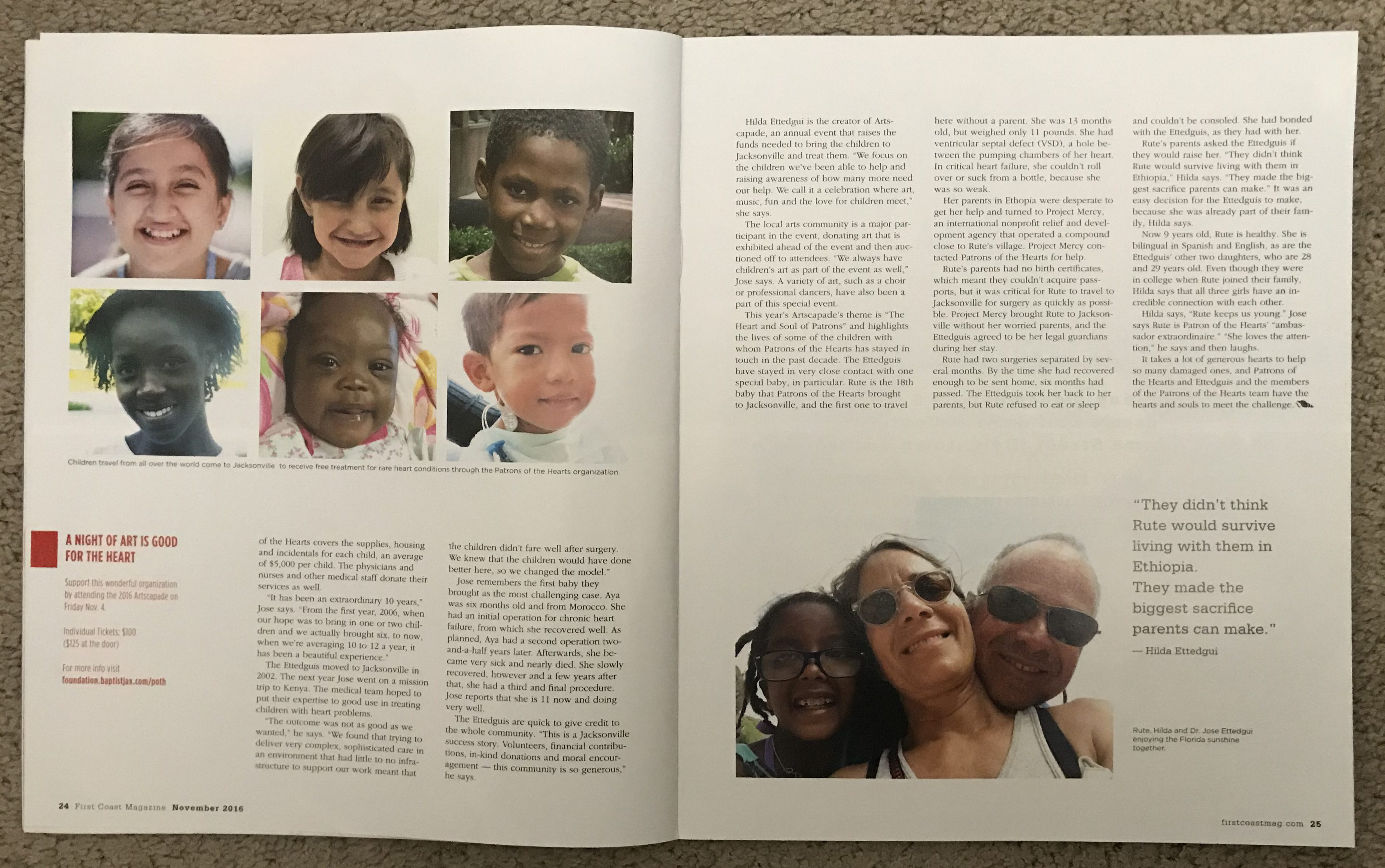
This year’s Artscapade’s theme is “The Heart and Soul of Patrons” and highlights the lives of some of the children with whom Patrons of the Hearts has stayed in touch in the past decade. The Ettedguis have stayed in very close contact with one special baby, in particular. Rute is the 18th baby that Patrons of the Hearts brought to Jacksonville and the first one to travel here without a parent. She was 13 months old but weighed only 11 pounds. She had ventricular septal defect (VSD), a hole between the pumping chambers of her heart. In critical heart failure, she couldn’t roll over or suck from a bottle, because she was so weak.

Her parents in Ethiopia were desperate to get her help and turned to Project Mercy, an international nonprofit relief and development agency that operated a compound close to Rute’s village. Project Mercy contacted Patrons of the Hearts for help.

Rute’s parents had no birth certificates, which meant they couldn’t acquire passports, but it was critical for Rute to travel to Jacksonville for surgery as quickly as possible. Project Mercy brought Rute to Jacksonville without her worried parents, and the Ettedguis agreed to be her legal guardians during her stay.

Rute had two surgeries separated by several months. By the time she had recovered enough to be sent home, six months has passed. The Ettedguis took her back to her parents, but Rute refused to eat or sleep and couldn’t be consoled. She had bonded with the Ettedguis, as they had with her.

Rute’s parents asked the Ettedguis if they would raise her. “They didn’t think Rute would survive living with them in Ethiopia,” Hilda says. “They made the biggest sacrifice parents can make.” It was an easy decision for the Ettedguis to make, because she was already part of their family, Hilda says.

Now 9 years old, Rute is healthy. She is bilingual in Spanish and English, as are the Ettedguis’ other two daughters, who are 28 and 29 years old. Even though they were in college when Rute joined their family, Hilda says that all three girls have an incredible connection with each other.

Hilda says, “Rute keeps us young,” Jose says Rute is Patron of the Hearts’ “ambassador extraordinaire,”

“She loves the attention,” he says and then laughs.

It takes a lot of generous hearts to help so many damaged ones, and Patrons of the Hearts and Ettedguis and the members of the Patrons of the Hearts team have the hearts and souls to meet the challenge.

Tradition is in Full Bloom at Kuhn Flowers

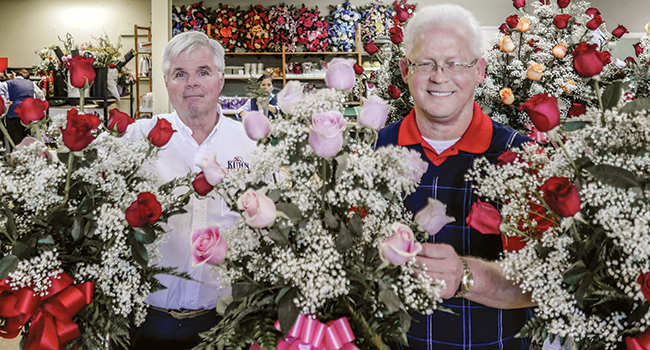
kuhnMy article #4 for First Coast Magazine appeared in its February 2016 issue. I was asked to write about a Jacksonville institution – Kuhn Flowers. The floral shop was long-established before I moved to Jacksonville in 1978, and its history is one of a true love story, most fitting for the month of roses, sweet nothings and romance. Read more here.

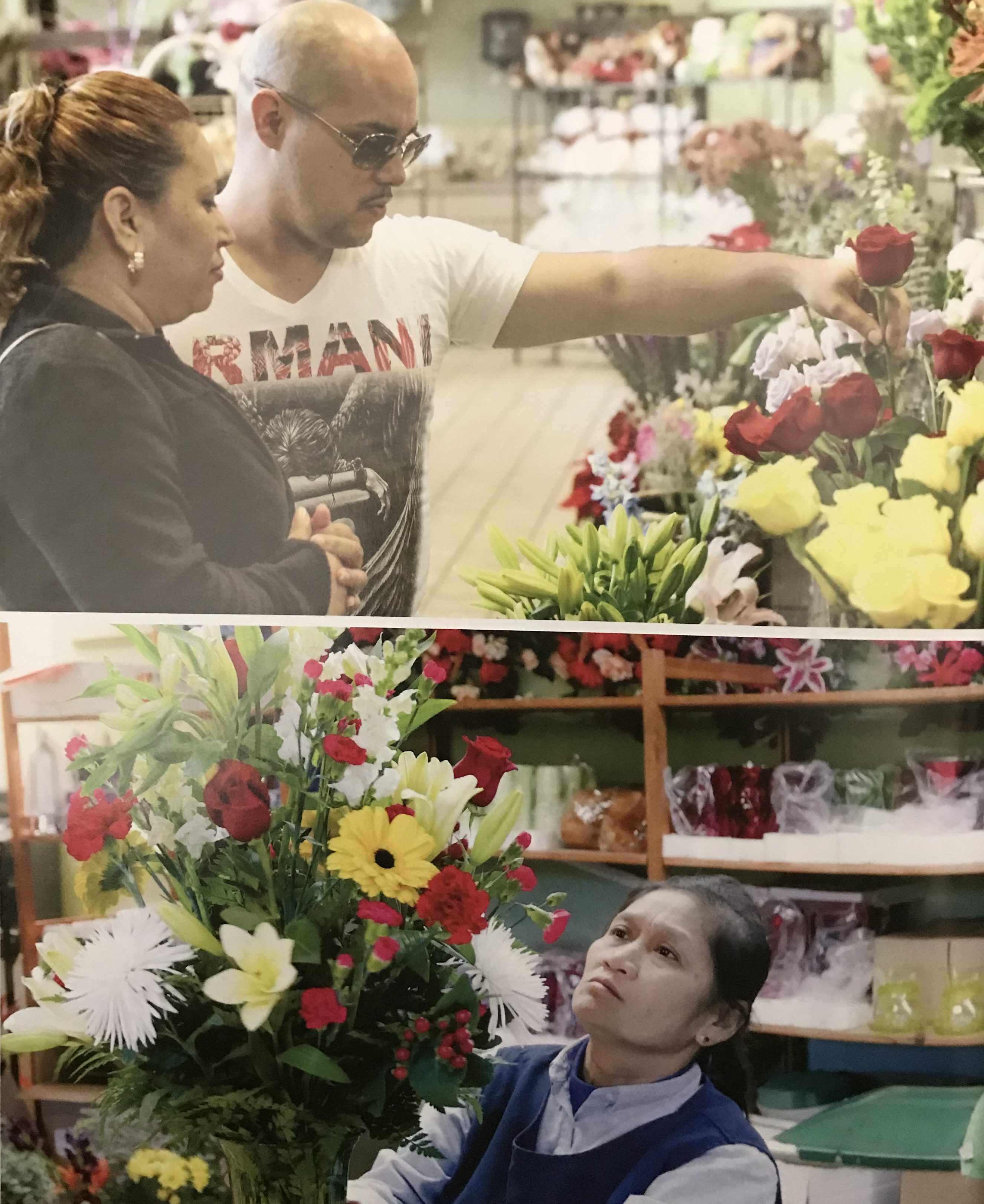
Valentine’s Day is Kuhn’s largest volume day, with more than 2,000 deliveries out of the Beach store alone. That requires 150 delivery people and 150 delivery vehicles. The store’s large volume allows it to buy flowers directly from growers, not via wholesalers, from around the world.

Kuhn Flowers was built with love. Nancy was the floral designer, and Bob Kuhn marketed and managed the business. Bob had worked in greenhouses as a kid, so opening Kuhn Flowers was a natural next set for him. Nancy and Bob married, and Kuhn Flowers became their life. It was the only business they ever owned. Bob bought up a number of smaller floral shops and rolled them into Kuhn Flowers after he relocated to Beach Boulevard in 1958. The Ponte Vedra Beach store is Kuhn’s only branch. “They both worked every day until they were about 70,” Howard says. They retired in 1984.

While no Kuhn family member is still a part of the business, traditions started by Nancy and Bob Kuhn 68 years ago, in the store’s first location in downtown Jacksonville, are still kept alive today. The seasonal celebration in Kuhn Flowers’ two-story storefront window is a Jacksonville destination, not just for locals, but regionally as well. Christmas decorations are up by Nov. 1 and stay up for 60 days.

“It used to be a tradition for many families to have Thanksgiving dinner and then pile everyone in the car to come see our Christmas window,” Howard says. McCall has revived the Kuhn window tradition for holidays. Santa has visited the store for the past seven years for children to have photos taken. “We hope to have the Easter Bunny visit as well,” McCall says. And, at Halloween, the employees dress up in costumes. And of course, there is a rose in every arrangement that leaves the store on Valentine’s Day. Both McCall and Howard buy their daughters flowers every Valentine’s Day. They do this to set an example for them, illustrating how women should be celebrated by the men in their lives.

“My best advice to a guy is to start now developing a personal relationship with a floral shop that delivers,” McCall says. “Then, the week before Valentine’s Day, he can call the store to have flowers delivered to his girl on Wednesday or Thursday before Sunday’s Valentine’s Day. This gives her plenty of time to show off to her girlfriends how much she is loved.”