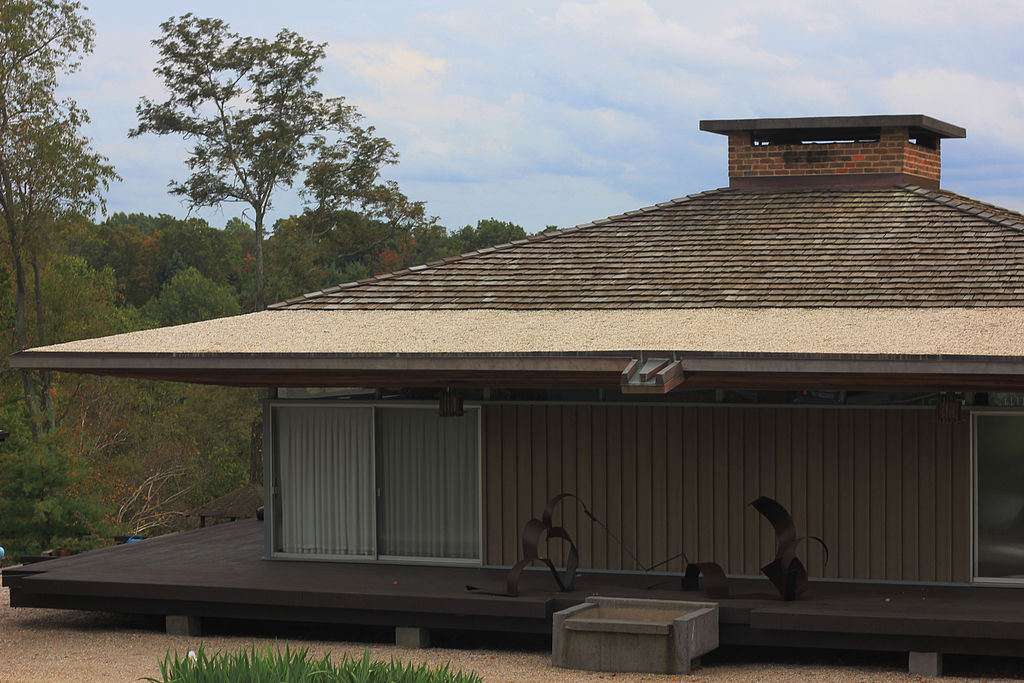
While in Blacksburg, Currie designed a number of homes in the International Style that he learned under Gropius and Breuer. The Currie house stands as a highly proficient and personal expression of 1960s Modernism, an architectural style influenced by the International Style of earlier decades. A rare instance where the architect was his own client, the house was designed in 1960 by Currie, head of the Virginia Polytechnic Institute school of architecture, for his own residence. He incorporated into his design Gropius’ and Breuer’s penchant for strong horizontality and large glass areas. Currie departed somewhat from his mentors’ industrial character by using a spreading hipped roof, a feature reminiscent of the works of Frank Lloyd Wright.
There are few award-winning, high-style modern houses of the Currie House’s era in the state, and in the southwest region it is recognized as the finest. Currie’s clear, formal statement of contemporary design received exception to the fifty-year rule for the National Register of Historic Places because of the rarity of similar architectural resources in southwest Virginia. The home’s deck offers a spectacular view from the Allegheny ridge above Blacksburg looking northeast to the Roanoke Valley and south to Christiansburg.
Completed in 1961, the house won American Institute of Architecture awards in 1962 and 1982. It was named to the Virginia Landmarks Register and the National Register of Historic Places (NPS property number 94000549) in 1994.
Currie sold the house in 1966 when he left the area to its present owner, W. Peter Trower, Ph.D., managing director of The Secular Society Inc. and retired Virginia Tech physics professor.
 Karen J. Rieley