KAREN RIELEY
PUBLISHED IN MARCH 2018 ISSUE OF THE RESIDENT NEWS –https://residentnews.net/2018/03/07/the-way-we-were-hank-bonar/
Henry Bascom (Hank) Bonar II grew up on a lake in Tampa and loved all that the water had to offer – boating, fishing, skiing and even duck hunting – so the opportunity to buy a house on the St. Johns River was one he couldn’t pass up. When his friend, Francis Langel, who worked at the time for the now defunct Stockton, Whatley, Davin & Company, urged him to buy Langel’s mother’s home on Morven Road, Hank examined his finances, worked up a budget and decided to buy it.
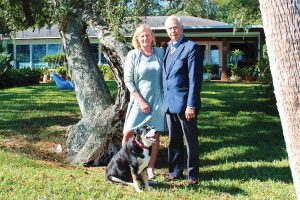
That was in 1975, the same year he opened his own business. “My first wife, Barbara, thought I was crazy,” Hank said. Hank himself thought he might be able to afford the house for maybe a year. Hank acknowledges that his timing was a little suspect, given that the country was still feeling the negative effects of the 1973-75 Recession.
“I guess I’m kind of the dean of Morven Road at this point,” said Hank, who, at age 77, has lived in the house for 42 years, well past original predictions.That was in 1975, the same year he opened his own business. “My first wife, Barbara, thought I was crazy,” Hank said. Hank himself thought he might be able to afford the house for maybe a year. Hank acknowledges that his timing was a little suspect, given that the country was still feeling the negative effects of the 1973-75 Recession.
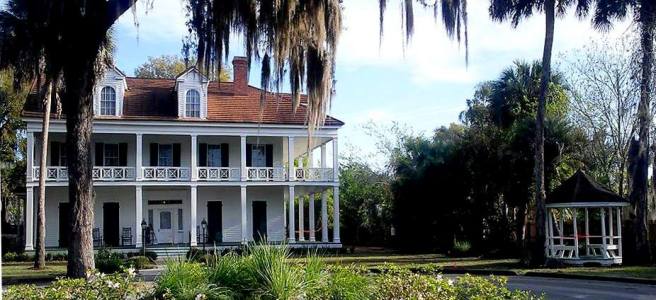
The home, built in 1941, sits on nearly one and three-quarters acres with amazing views of the Jacksonville skyline along the St. Johns River. It is the second largest home site on the road and has a huge rear yard lined with oak trees.
The house is unique among others on Morven Road as it is a one-story home. Hank renovated the house, most notably so that it would have no steps, a design feature that, while more common now, was unusual at the time. That turned out to be a help because Barbara was in a wheelchair before she died from pancreatic cancer in 2002.
The most unusual room in the house is the bar between the family room and living room. It features the original cypress wood from the Ponte Vedra Inn and Club bar. The house was designed by a New York architect in the Prairie School style that Frank Lloyd Wright and Henry Klutho made famous.
“This was a perfect environment for our two sons to grow up in,” Hank said. “They had woods for adventures, bonfires, dock parties, easy access to water so that they could enjoy our boat.” They named their boat “Skiduckfish,” because they used it to waterski, hunt ducks and fish.
Barbara also grew up in Tampa and met Hank in high school. Hank attended the University of the South for two years on full scholarship. “I wouldn’t give anything for that experience,” he said. Then, he went to the University of Florida for his engineering degree. Barbara and he moved to Jacksonville in 1967, and Hank spent a few years working for a construction company until he opened his own business, Bonar Engineering and Construction on Edgewood Avenue in 1975. Hank’s company provides engineering, general construction, refrigeration and training courses.
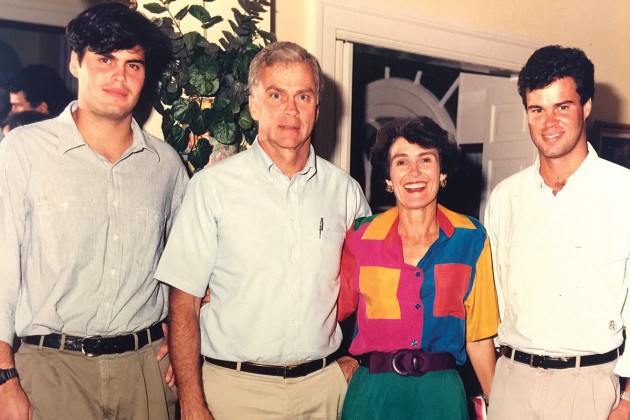
They have two sons, Henry III and Robert Gregory Bonar. Henry attended The Bolles School, and both sons graduated from The Episcopal School of Jacksonville. They inherited their father’s love of sports, playing soccer, tennis and especially football.
After college, Henry III spent a lot of time in Honduras and eventually married Jessica, a native of Honduras. They have two children, Henry IV and Valerie. Robert lives in California with wife Heather, from Connecticut. They have three children, Robert Gregory Bonar, Jr., Anna Barbara and Nick.
Like many admiring sons, Hank wanted to follow in his father’s footsteps in the refrigeration industry. But, just following Henry B. Bonar Sr. wasn’t enough. Hank want to take refrigeration further, and he has accomplished his goal.
Hank’s relationship with freezing goes all the way back to his grandfather, however. Hank’s grandfather moved the family from the home place in Kentucky to New Mexico then to Okeechobee, Florida, in the early 1900s, when Hank’s father, Hank Sr., was a boy. Now deceased, Hank Sr. used to tell stories about his father bringing home chunks of ice from the Okeechobee ice plant.
Hank included a quote by his father in his book that hints at his own philosophy of industrial refrigeration: “The biggest breakthrough in refrigeration really came when God made water freeze at 32 degrees Fahrenheit and turn to steam at 212 degrees Fahrenheit. These are the cornerstones of our knowledge. Then God related the growth of bacteria to these temperatures. These are the facts we live – or die – with. It’s up to man to take it from there.”
Today, his six employees, including son Henry, and he design and oversee construction of some of the largest, most complex, cutting-edge freezer and refrigeration facilities all over the world, including India, Russia, Ukraine, Trinidad, the Cayman Islands, St. Kitts (an island in the West Indies), and more. They primarily work with ammonia refrigerant to cool public refrigerated processing facilities as well as warehouses that serve just one company, such as Publix.
Hank has worked closely with the International Association of Refrigerated Warehouses. He is often asked to advise professionals in other countries who want to learn more about the niche industry of big refrigeration. “They seek out our company because the local A & E’s (architects and engineers) don’t know how to build big refrigeration buildings correctly, and we have the reputation of being trustworthy and capable of doing the job right,” Hank said.
With his son, Henry, Hank has reached out to help the citizens of Puerto Rico. When one of their good clients said that they needed a generator, Henry found a $115,000 industrial generator and sent it to the country in faith that he would eventually be paid. To meet the need for home generators, Hank bought 30 and sent them to Puerto Rico, too. The company sent a repair person to Puerto Rico, as well, to help repair generator buildings, refrigeration systems for food and roofs. Henry and the repair person have been making regular trips to continue the work.
Hank has accomplished so much in the fields of engineering, construction and refrigeration facilities one could easily define the man by his work. What really drives Hank, however, is sharing his knowledge.
“Education is my thing,” he said. “It is the hallmark of good living standards.”
Bonar’s book, Florida Comes of Age, tells the history of Florida’s refrigeration and frozen food distribution. He wrote the book partly as a way to help developing countries envision how they might handle perishable food more effectively.
“If the insights presented here help save or improve the quality of life of one individual, I have received my reward,” he wrote in the acknowledgments in his book. Maybe that is why he dedicated the second edition to “The Hungry Children of the World.”
“The evolution of refrigeration and the changing face of Florida are inextricably bound,” he wrote. Likewise, he believes, it is for developing countries. “Some of these places don’t even know what refrigeration is all about,” Hank said.
His belief in the importance of education led Hank to establish The Casey Carter Bonar Leadership Award in 2010 for Vanderbilt University to honor the memory of his late wife, Casey Carter Bonar, who Hank married after first wife Barbara died in 2007.
The university’s description of the award speaks to the many positive qualities of Casey, who died in 2010: “Based on the legacy of extraordinary leadership she left behind, this award is presented annually to a Vanderbilt undergraduate student who embodies the unique qualities that Casey brought to the university – leadership, broad collaboration, enthusiasm, passion for campus involvement, selfless service to Vanderbilt, and, always, dedication to positive change.”
Hank is engaged to Nancy Soderberg, a foreign policy expert who moved to Jacksonville 12 years ago and has taught at the University of North Florida for 10 years as Distinguished Visiting Scholar and Director of Public Policy Initiatives. Currently, she is running for Ron DeSantis’ seat in Congress in Florida’s sixth congressional district.
“Nancy’s thing is negotiating,” Hank said. “She gets things done.”
She founded the Public Service Leadership Program at UNF when she arrived and uses her extensive contacts in government and the nonprofit world to build a network of opportunities for UNF students to gain first-hand experience in the field, building their resume and contacts —keys to future employment.
Nancy and Hank say they are amazed at how many of the same countries they have visited throughout their lives but not at the same time. Elizabeth Head, who is the former associate vice president of development at University of North Florida, introduced Nancy and Hank seven years ago. Hank had been given tickets to the Florida Forum Speaker Series when Bill Clinton was scheduled to speak. He wanted someone to go with him, and Elizabeth suggested Nancy.
“Do you think she’d want to go with me?” Hank asked Elizabeth. She did.
“Hank later asked me to go to a boat show with him,” Nancy recalled. “I thought it was going to be a small boat. Well, a small boat did pick me up, but it took me to Hank’s 67-foot yacht that he calls ‘The Magic Castle,’ because, before Hank bought it, the boat belonged to a family relative who was a magician.”
With Hank, there is always something more to learn. Hank’s hobbies are quite a departure from big refrigeration systems. He loves woodworking and made all the continuous-bow Windsor armchairs in his dining room. He won first place in the Florida State Fair for one of the other chairs he made. He likes to paint as well, and his works are hung around the house.
Also on shelves and tables throughout the house are examples of agatized coral, which his father got the State of Florida to officially declare in 1979 as the state stone. The coral is cut open and the exposed interior surface is polished until it is smooth and shiny to show its beautiful colors.
“I have tons of these pieces of coral stored in boxes that I hope will be displayed somewhere someday,” Hank said.
Hank is fond of motivational sayings, too. One of his favorite is “You’re only as old as you think you are.” A favorite toast of his is “May the best in your past be your worst in your future.” And, “Remember this is not a dress rehearsal.”
With Hank, there is always something more to learn.