For much of the mid-twentieth century, modern forms of architecture were few and far between in Virginia. The restoration of Colonial Williamsburg heavily influenced Virginia’s mid-century residential architecture. In the early twentieth century, several revival styles were popular choices for homes, but Georgian derivatives dominated once Colonial Williamsburg opened to the public. After World War II, a more modem aesthetic emerged as a housing shortage led to many housing developments across the state. However, the developments—often designed by builders and not by architects—were rarely planned with any architectural aspirations. In the early 1960s, Thomas K. Fitzpatrick, Dean of the Architecture program at the University of Virginia, bemoaned “Modern architecture in Virginia of significant importance is almost non-existent.” Builders were generally blamed as most feared alienating the public’s preference for Williamsburg style.
Currie House I as Example of 1960s Modernism/International Style Architecture in Southwest Virginia
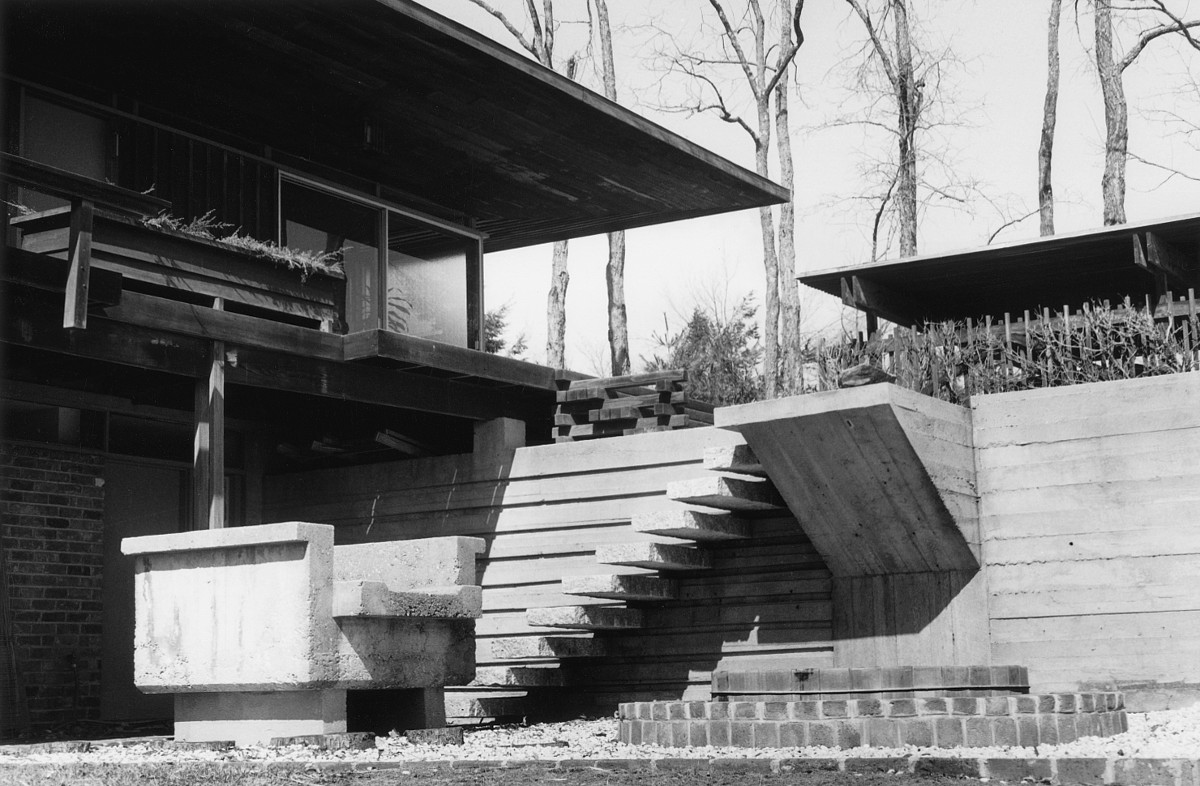
The Currie House represents a significant break from traditional Virginia architectural styles. In contrast to these trends, Currie utilized his training in the Modern Style, or the International Movement as it is often referred. The distinguishing principles of the International Style are: “emphasis upon volume; space enclosed by thin planes or surfaces as opposed to the suggestion of mass and solidity; regularity as opposed to symmetry or other kinds of obvious balance; and, lastly, dependence upon the intrinsic elegance of materials, technical perfection, and fine proportions (as opposed to applied ornament).” With the Currie House, the use of floor-to-ceiling glass, particularly at the comers of the house, reveal that it is the skeletal wood frame, not the walls, bearing the weight of the roof. This increases the impression of a volume of space perched at the edge of a hill, merely wrapped in an enclosure of glass and wood with a large roof hovering over it.
The expansive, sheltering roof—the only feature of the house that seems counter to the ideas of the International Style—returns to earlier ideas of Currie’s. The architect recalled that one of his first architectural influences was Frank Lloyd Wright. Wright, who disliked the machine-like buildings of many International Style architects, thought a house should communicate clearly its function as a haven and refuge for a family. He often tucked doorways into darkened, secluded passages, difficult for newcomers to find. Though the entrance to the Currie House is not obscure, it is indirect. Many of Wright’s residential interiors were compared to caves—basic, encompassing shelter from the world for a family unit. Although the main level of the Currie House is anything but cave-like, at the lower level, the area set aside for the children, a deliberate attempt was made to invoke a protective, cave-like ambience.
Further, Currie remarked that the nickname of the house (Pagoda House) and the implication that the design is based on Asian structures are misleading. Though Wright was influenced by Asian architecture, and Currie was fascinated by Wright, Currie did not deliberately set out to design a “pagoda”; he set out to design an International Style home with a few significant nods to Wright.
Source: “Selected Modernist Architects in Virginia: Biographical Sketches” by Josh Howard, Doctoral Student in the Middle Tennessee State University Public History Program on behalf of the Virginia Department of Historic Resources, Richmond, Virginia, December 2013, https://www.dhr.virginia.gov/pdf_files/newdominion/ArchitectBios_Howard_Final.pdf
 Karen J. Rieley