Leonard James Currie and James Adger Smyth Johnson

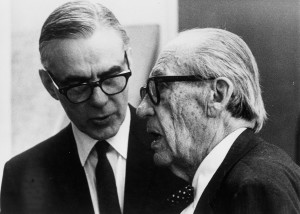
Leonard Currie with Walter Gropius
Leonard Currie with Walter Gropius https://50years.caus.vt.edu/history/

In the late 1950s and early 1960s, two men – Leonard James Currie, American architect, planner, educator, and James Adger Smyth Johnson, retired vice chairman and a director of Union Carbide Corporation, graduate of Virginia Tech and former member of Tech’s Board of Visitors – made indelible marks on both Virginia Tech and the town of Blacksburg. Several homes in Montgomery County still stand as monuments to their commitment to bring International Style architecture to southwest Virginia.

Leonard James Currie, who was born in 1913 and died in 1996, came to Blacksburg in 1956 to teach architecture at Virginia Tech. In 1956, Currie was appointed to replace the retiring Clinton Cowgill as department head of architecture.

He received a bachelor’s degree in architecture from the University of Minnesota in 1936 and a master’s degree in architecture from Harvard University in 1938. He did an apprenticeship with Walter Gropius and Marcel Breuer, 1938 – 1940, and was a Wheelwright traveling fellow, 1940 -1941. Gropius was head of the Bauhaus in Berlin, 1919 – 1928. Gropius and his Bauhaus protégé, Marcel Breuer, both moved to Cambridge, Massachusetts, to teach at the Harvard Graduate School of Design. Currie was a student of both and a subsequent colleague of Walter Gropius at The Architects Collaborative (TAC).

Currie joined the Carnegie Institute’s archaeological expedition to Copan, Honduras in 1941 and assisted Pan Am Airways and the U.S. Government in the construction of airport facilities in Guatemala and Nicaragua, 1941 – 1942. He served as an officer in the United States Army, 1942 – 1945, retiring as a lieutenant colonel.

He then was named assistant professor of architecture at Harvard University, 1946 – 1951. Currie provided technical assistance to the U.S. government and other institutions in Costa Rica, 1951, and served as director of the Inter-Am Housing Center in Colombia, 1951 – 1956. After he returned to the United States in 1956, he chaired the architecture department at the Virginia Polytechnic Institute.

As department head, Currie added urban design and planning to the curriculum, which became a degree program. Art courses were actively taught as support courses for the architecture degree and for the university community at large. Currie introduced international content into the curriculum and recruited new faculty with significant national and international stature.

He left Virginia Tech in 1962 to become dean of the College of Architecture and Art at the University of Illinois, Chicago, 1962 – 72. Currie continued his work as a professional architect, educator, and planner throughout the 1970s and 1980s. No longer dean, he continued to serve as a professor at the University of Illinois at Chicago, 1972 – 1981, as a Fulbright Senior Fellow, 1972 – 1973, and as a visiting professor at international universities. A partner in the firm Atkins, Currie and Payne, he later headed Leonard Currie and Associates.

Currie served as a member of the Chicago Cultural Commission, 1963 – 1966, as a co-promulgator of the Charter of Machu Picchu. He authored numerous books and articles including Housing in Costa Rica (with Rafaela Espinosa), Planning of Central American Campuses, and Designing Environments for the Aging. Involved in many different projects, Currie’s achievements include work on the Rockefeller Foundation, planning for the campus of the National University of Nicaragua, and award-winning residential homes.

He participated on various college committees and represented Virginia Tech both nationally and internationally. He endowed a scholarship in the name of his granddaughter, Michelle Currie, and funded an award for teaching excellence in the college.

Currie achieved status as a fellow of the American Institute of Architects, and in 1993, received the Virginia AIA Chapter’s highest award, the William C. Noland Medal. At CAUS awards ceremony in April, Currie was presented a special lifetime achievement award. For his achievements and outstanding service to the college, he was recently named professor emeritus of architecture.

While in Blacksburg, Currie designed a number of homes in the International Style that he learned under Gropius and Breuer. One of the homes he designed was for James Adger Smyth Johnson and his first wife, Elizabeth Jenkins Johnson, at 1620 High Knob Lane in 1962.

The house is a mid-century modern classic sitting on 66 private acres on High Knob along Cedar Run Road off of Ellett Road and adjoining the town limits of Blacksburg, Virginia. It overlooks the Ellett Valley in Montgomery County, Virginia. Nearly 64 acres of the 66 are forested.

Johnson retired as vice chairman and a director of Union Carbide Corporation. A graduate of Virginia Tech, he began his career with the National Carbide Division of Union Carbide in Cleveland, Ohio. He served as general manager of the Eveready Battery Company in Shanghai, China, during the 1930s. Following his return to the United States he held a variety of senior management positions with Union Carbide prior to be being appointed vice chairman in 1967. Johnson, who died in 1999 at the age of 91, was a former member of the Board of Visitors of Virginia Tech.
The Way We Were: Dr. Maria Acosta-Rua

BY KAREN RIELEY
PUBLISHED IN JANUARY 2018 ISSUE OF THE RESIDENT NEWS – http://residentnews.net/2017/12/05/youth-learns-lessons-homelessness-7th-annual-cardboard-city/

Dr. Maria Acosta-Rua and her late husband, Dr. Gaston Acosta-Rua, have never forgotten their past even as they contributed so much to their Jacksonville community. Theirs is truly an international tale, in which they have intertwined their Spanish and American lives to the benefit of both.

AcostaRua_01-200x300
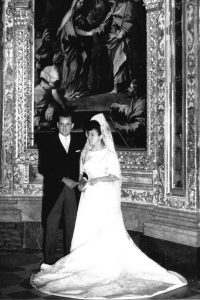
Acosta-Rua wedding in front of “The Marriage of the Virgin Mary and St. Joseph” in the Monastery of Guadeloupe

As soon as they graduated, he moved to Miami to work hard, save money and take his Educational Council for Foreign Medical Graduates (ECFMG) exam, but he promised he would come back for her in Madrid in a year. He kept his promise, and they were married two weeks later in the Monastery of Guadeloupe, because he had to start an internship in Cleveland very soon.Gaston Acosta-Rua and Maria Victoria Pol Gimenez met in Madrid in their last year of medical school. Gaston was a counter-revolutionary who escaped from Cuba, and Maria was from Madrid.

Maria found herself in a new country, with a new husband who worked rotation in the hospital every other night, in what seemed to her to be gloomy Cleveland compared to Madrid, where she remembers people always out in the streets visiting with each other. She became pregnant almost immediately so that meant she would soon be a new mother in addition to being a young wife.

“It was a real cultural shock for me, and I felt very lonely and depressed,” Maria said. But, once Gaston Jr. was born, she had someone to care for and occupy her time. She began to meet people in the neighborhood when she took baby Gaston out for walks.

As she gradually adjusted to her new life, she started thinking about her own career and studying to take ECFMG exam herself.

“It was not an easy task,” Maria said. “The exam was in English and included subjects from all of the medical school courses, which I had studied in Spanish.” But she persevered and became a “real” doctor.

In 1967, Gaston moved to Iowa City to start his neurosurgical residency. Maria and Gaston Jr. stayed in Cleveland until she completed her internship the following June.

AcostaRua_04-200x300
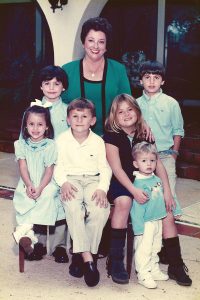
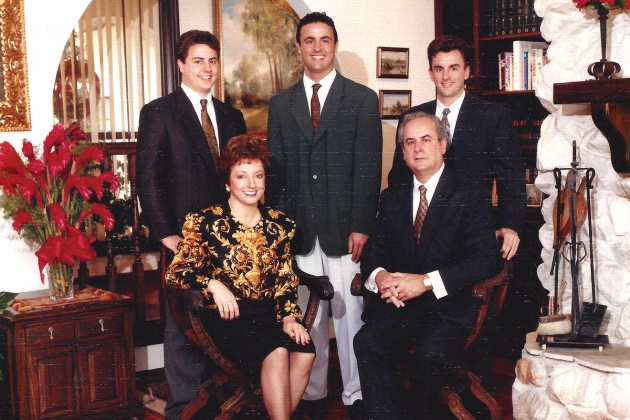
Maria Acosta-Rua with her grandchildren: Somerset (seated), Alex and Daría (in the front), Andrew (standing), Mills and Fernando Jr. (back), circa 2005

Gaston Jr. now lives in Connecticut with his wife, Lianne. Fernando was born soon after they moved to Iowa and right before Maria began her child psychiatry training. He lives in Jacksonville and is the CEO of Pet Paradise. Tony, who was born when Maria was mid-way through child psychiatry training, lives in Costa Rica with his wife, Adriana. Maria now has six grandchildren – three each by Gaston Jr. and Fernando.

After completing their training, they wanted to move to Florida. Like most Cubans, Gaston hoped he could return to Cuba someday and Florida was as close as he could get us to Cuba,” Maria said.

They thought they would move to Miami, but Gaston’s chief resident in Iowa, Dr. Tom Boulter, who was by then practicing in Jacksonville, found him a position with Lyerly Neurosurgery in Riverside.

The doctor rented a house for them on Ortega Boulevard, and they ended up liking the neighborhood so much that after two years they bought a house on Long Bow Road, where they lived from 1975 to 1981. Next, they moved to Ortega Forest, where Maria still lives.

After moving to Jacksonville, Maria was determined to put her education to work. In 1973, she started her child psychiatry practice on Oak Street in Riverside.

She was a pioneer as the very first child psychiatrist in Jacksonville. She worked the longest with children at Daniel Kids and has also worked with many other nonprofits that provide services to children, for example, Youth Crisis Center, Florida Baptist Children’s Homes, Child Guidance Center, Children’s Home Society, the Florida School for the Deaf & Blind, Jacksonville Youth Sanctuary, Northeast Florida State Hospital and Boys Home Association of Jacksonville, in addition to her own private practice. For the last 15 years of her career, Maria worked with foster children.

“I started the first day treatment facility for emotionally disturbed children with St. Vincent’s and the school system, and then I started a children’s psychiatric ward with Baptist,” said Maria, who retired three years ago.

AcostaRua_02-300x200
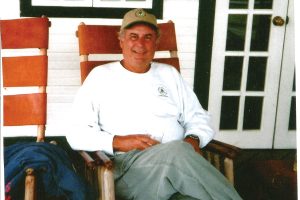
Gaston Acosta-Rua relaxing on the porch of his Costa Rican farm

Maria shares Gaston’s story of escaping from Cuba. “He was 21 years old and working underground against Castro,” she said. “The government was looking for him to put him in prison.”Maria is very proud of the work her husband did, not only in Jacksonville, but in Mexico, Costa Rica and Africa as well. “Gaston was an excellent neurosurgeon and worked in every hospital in Jacksonville,” she said. “He did missionary work for more than 20 years. Going with a Mercy Ship to Africa in 1995 was the highlight of his life.”

He was introduced by his mother to Fidel Castro’s sister, who was anti-Communist. She arranged for Gaston to get on a plane out of Cuba, rather than having to escape by boat. After a brief stay in Costa Rica, Gaston eventually traveled to Miami.

Gaston returned to Cuba only once in 1998. He traveled with a Catholic organization called the Order of Malta to bring wheelchairs to Daughters of Charity for the home they were running for severely handicapped children and adults.

The Acosta-Ruas have contributed much to Jacksonville’s medical sector. “Even now, when I sign something people often recognize the last name and remember that one of us helped them,” Maria said.

Gaston kept feeling drawn to help people in Costa Rica, so much so that he bought a farm there. He helped with medical and social contributions.

In 2002, Gaston was diagnosed with pancreatic cancer. As physicians, Maria and he both knew that this meant the end. “He was never in hospice,” Maria said. “Gaston knew what was coming and was determined to live each day to the fullest.”

He went back to work, played tennis and decided to write about his childhood and his experiences in Cuba, his escape and his memories of life for his children and grandchildren. He also established the Acosta-Rua Family Foundation, with the mission to relive the burden of the poor and the sick, both locally and in Latin America.

AcostaRua_05-300x200
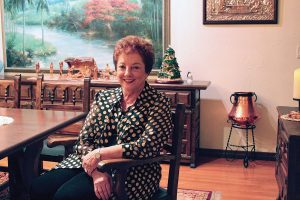
Maria Acosta-Rua relaxes at home in Ortega Forest.

Gaston passed away seven months after he was diagnosed. After his death, their son, Fernando, became involved with Community Hospice & Palliative Care. He is presently the chairman of organization’s Board of Directors and a member of its foundation. The Acosta-Rua family made a naming gift for a new 16-bed center called “The Dr. Gaston J. Acosta-Rua Center for Caring” in Gaston’s memory.

Fernando and his wife, Brooke, have held seven fundraising events called “A Sunset in Costa Rica” to benefit both the Children’s Hospice in Costa Rica, and Community PedsCare (pediatric hospice and palliative care) in Jacksonville. When a second hospice was built recently in Costa Rica, it was named “Doctor Gaston Acosta-Rua Center.”

At the time of this interview, Maria and various other friends and workers were busily preparing for the Acosta-Rua family’s annual celebration of Gaston’s escape from Cuba. They used to hold the event on the actual date of his escape, Dec. 28, but now they hold it earlier in the month when it is most convenient. Fernando and Tony roast a whole pig outside. Maria prepares black beans, rice and salad for more than 100 people.

When Maria and Gaston first moved to Ortega Forest, mostly Cuban friends attended, but now friends of their children and their families are the majority of those attending. Many of them are Bolles alumni because all three sons played football for and graduated from the private school in the San Jose area on the St. Johns River. Tony also played Bolles baseball. Fernando is currently a member of Bolles’ Board of Trustees.

The Acosta-Ruas Spanish-style home built in 1981 and Spanish furnishings that they collected from their many trips are the perfect backdrop to the event and reflect their commitment to giving back to help people from the communities of their past and present.

The epigraph in Acosta-Rua … Las Memorias, written by Gaston and Maria Acosta-Rua with Susan D. Brandenburg, exemplifies the Acosta-Ruas’ lives: “To be ignorant of what occurred before you were born is to remain always a child for what is the worth of human life unless it is woven into the lives of our ancestors by the record of history.” (Cicero 106 BC)