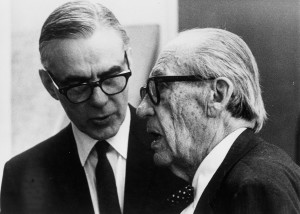
In the late 1950s and early 1960s, two men – Leonard James Currie, American architect, planner, educator, and James Adger Smyth Johnson, retired vice chairman and a director of Union Carbide Corporation, graduate of Virginia Tech and former member of Tech’s Board of Visitors – made indelible marks on both Virginia Tech and the town of Blacksburg. Several homes in Montgomery County still stand as monuments to their commitment to bring International Style architecture to southwest Virginia.
Leonard James Currie, who was born in 1913 and died in 1996, came to Blacksburg in 1956 to teach architecture at Virginia Tech. In 1956, Currie was appointed to replace the retiring Clinton Cowgill as department head of architecture.
He received a bachelor’s degree in architecture from the University of Minnesota in 1936 and a master’s degree in architecture from Harvard University in 1938. He did an apprenticeship with Walter Gropius and Marcel Breuer, 1938 – 1940, and was a Wheelwright traveling fellow, 1940 -1941. Gropius was head of the Bauhaus in Berlin, 1919 – 1928. Gropius and his Bauhaus protégé, Marcel Breuer, both moved to Cambridge, Massachusetts, to teach at the Harvard Graduate School of Design. Currie was a student of both and a subsequent colleague of Walter Gropius at The Architects Collaborative (TAC).
Currie joined the Carnegie Institute’s archaeological expedition to Copan, Honduras in 1941 and assisted Pan Am Airways and the U.S. Government in the construction of airport facilities in Guatemala and Nicaragua, 1941 – 1942. He served as an officer in the United States Army, 1942 – 1945, retiring as a lieutenant colonel.
He then was named assistant professor of architecture at Harvard University, 1946 – 1951. Currie provided technical assistance to the U.S. government and other institutions in Costa Rica, 1951, and served as director of the Inter-Am Housing Center in Colombia, 1951 – 1956. After he returned to the United States in 1956, he chaired the architecture department at the Virginia Polytechnic Institute.
As department head, Currie added urban design and planning to the curriculum, which became a degree program. Art courses were actively taught as support courses for the architecture degree and for the university community at large. Currie introduced international content into the curriculum and recruited new faculty with significant national and international stature.
He left Virginia Tech in 1962 to become dean of the College of Architecture and Art at the University of Illinois, Chicago, 1962 – 72. Currie continued his work as a professional architect, educator, and planner throughout the 1970s and 1980s. No longer dean, he continued to serve as a professor at the University of Illinois at Chicago, 1972 – 1981, as a Fulbright Senior Fellow, 1972 – 1973, and as a visiting professor at international universities. A partner in the firm Atkins, Currie and Payne, he later headed Leonard Currie and Associates.
Currie served as a member of the Chicago Cultural Commission, 1963 – 1966, as a co-promulgator of the Charter of Machu Picchu. He authored numerous books and articles including Housing in Costa Rica (with Rafaela Espinosa), Planning of Central American Campuses, and Designing Environments for the Aging. Involved in many different projects, Currie’s achievements include work on the Rockefeller Foundation, planning for the campus of the National University of Nicaragua, and award-winning residential homes.
He participated on various college committees and represented Virginia Tech both nationally and internationally. He endowed a scholarship in the name of his granddaughter, Michelle Currie, and funded an award for teaching excellence in the college.
Currie achieved status as a fellow of the American Institute of Architects, and in 1993, received the Virginia AIA Chapter’s highest award, the William C. Noland Medal. At CAUS awards ceremony in April, Currie was presented a special lifetime achievement award. For his achievements and outstanding service to the college, he was recently named professor emeritus of architecture.
While in Blacksburg, Currie designed a number of homes in the International Style that he learned under Gropius and Breuer. One of the homes he designed was for James Adger Smyth Johnson and his first wife, Elizabeth Jenkins Johnson, at 1620 High Knob Lane in 1962.
The house is a mid-century modern classic sitting on 66 private acres on High Knob along Cedar Run Road off of Ellett Road and adjoining the town limits of Blacksburg, Virginia. It overlooks the Ellett Valley in Montgomery County, Virginia. Nearly 64 acres of the 66 are forested.
Johnson retired as vice chairman and a director of Union Carbide Corporation. A graduate of Virginia Tech, he began his career with the National Carbide Division of Union Carbide in Cleveland, Ohio. He served as general manager of the Eveready Battery Company in Shanghai, China, during the 1930s. Following his return to the United States he held a variety of senior management positions with Union Carbide prior to be being appointed vice chairman in 1967. Johnson, who died in 1999 at the age of 91, was a former member of the Board of Visitors of Virginia Tech.


