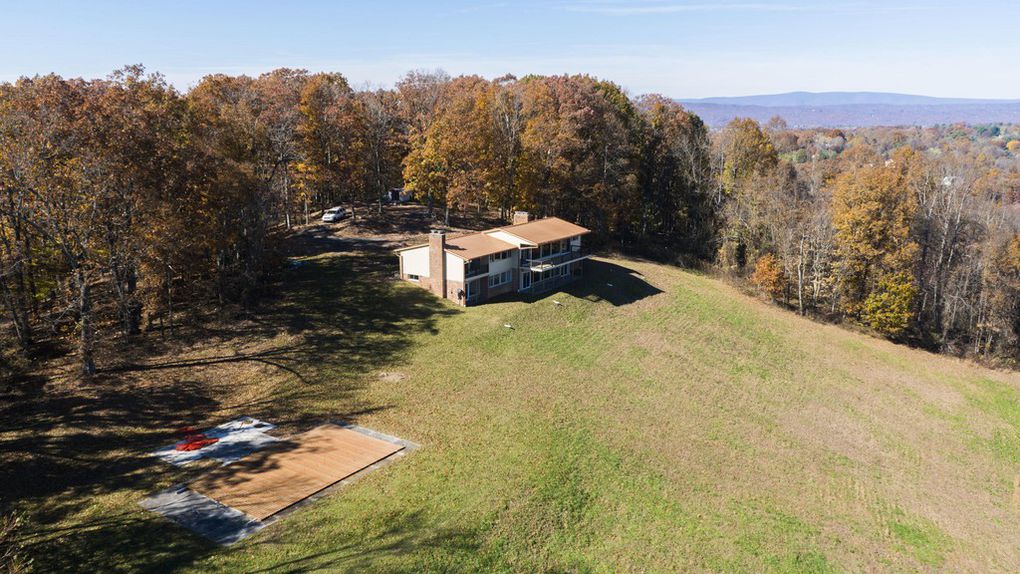
High Knob House, 1620 High Knob Lane, Blacksburg, Va.

High Knob
High Knob

Currie also designed the house at 1620 High Knob Lane in 1962 for James Adger Smyth Johnson and his first wife, Elizabeth Jenkins Johnson.
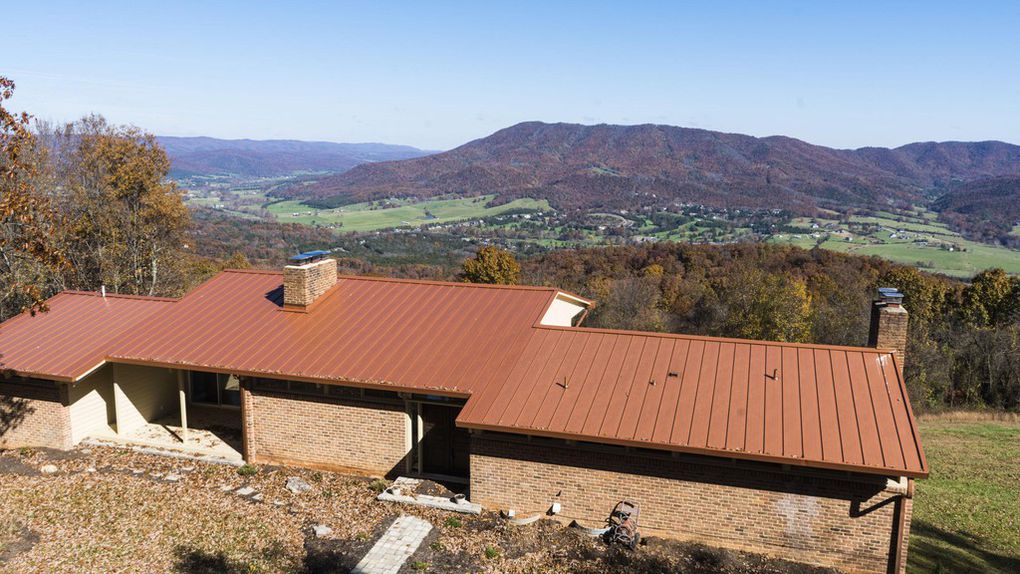
The house is a mid-century modern classic sitting on 66 private acres on High Knob along Cedar Run Road off of Ellett Road and adjoining the town limits of Blacksburg, Virginia. It overlooks the Ellett Valley in Montgomery County, Virginia. Nearly 64 acres of the 66 are forested.
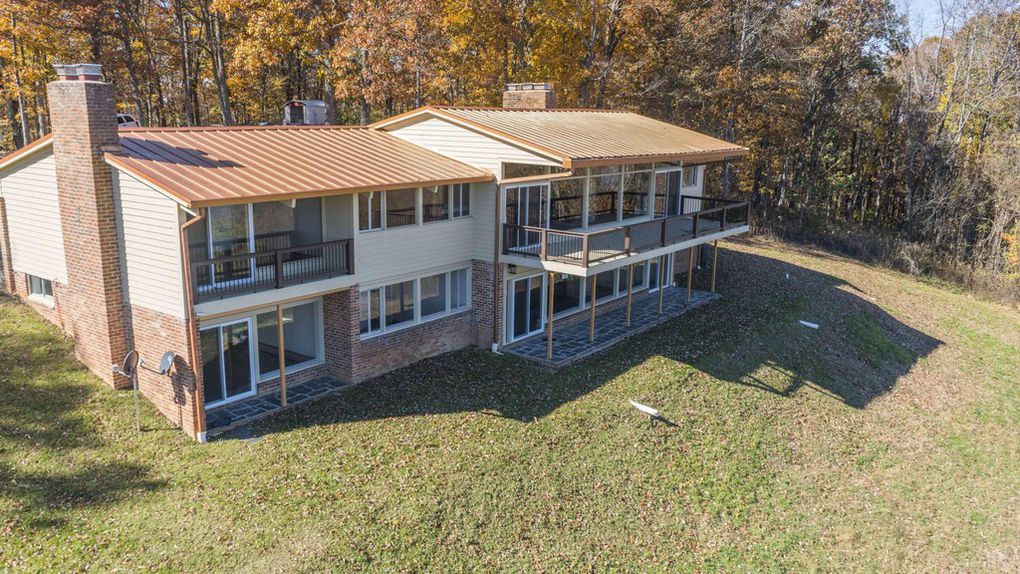
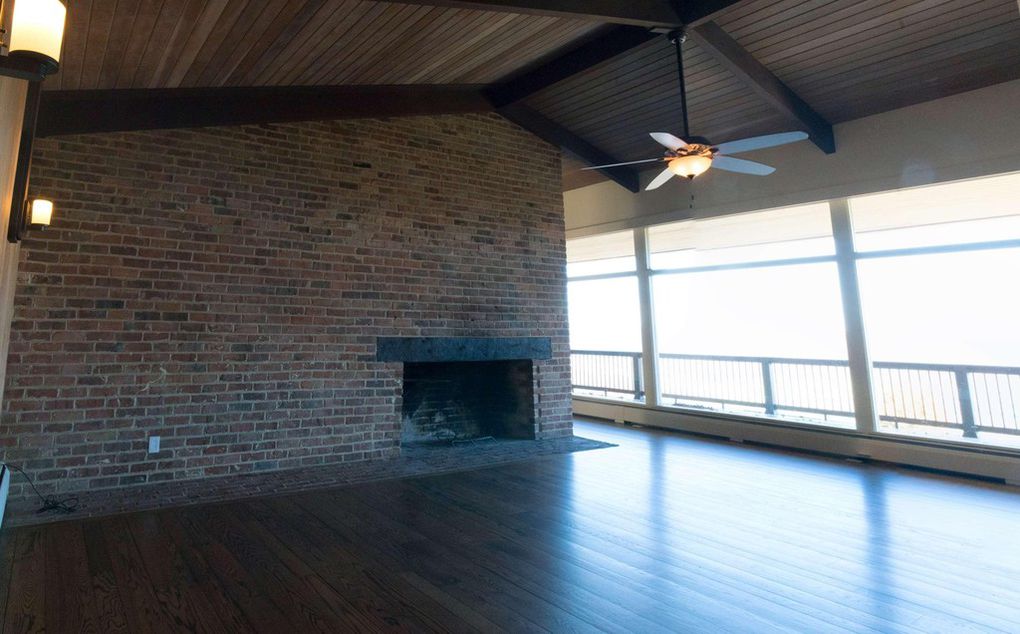
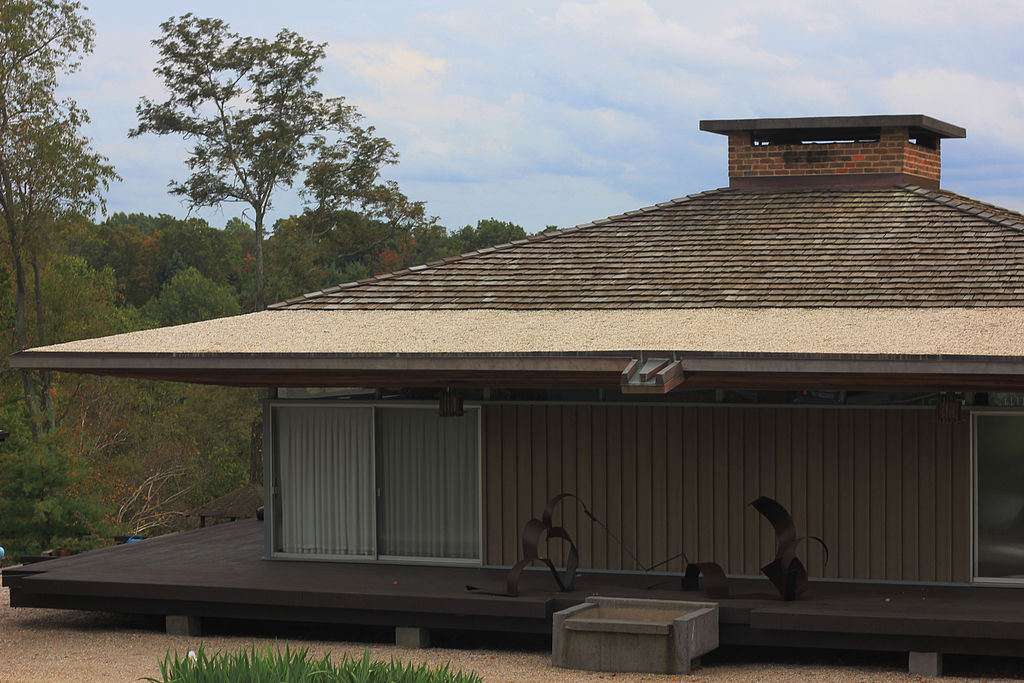
The house is 4,800 SF with a large main level deck and matching patio below and expansive windows throughout. In addition to master suites on both levels with direct access to the balcony or patio, there are two more bedrooms and four full and one half baths. The interior features rare wormy chestnut paneling, random-width pegged hardwood flooring and four fireplaces built of bricks from original Virginia Tech faculty houses built in 1893 – 1894 along a lane in the vicinity of today’s Pamplin Hall, Burruss Hall, and Norris Hall on what was then called Faculty Row. The exterior is brick and wood siding with a new metal roof that replaced the original cedar shake shingled roof. An in-ground pool is also on the property.
Johnson retired as vice chairman and a director of Union Carbide Corporation. A graduate of Virginia Tech, he began his career with the National Carbide Division of Union Carbide in Cleveland, Ohio. He served as general manager of the Eveready Battery Company in Shanghai, China, during the 1930s. Following his return to the United States he held a variety of senior management positions with Union Carbide prior to be being appointed vice chairman in 1967. Johnson, who died in 1999 at the age of 91, was a former member of the Board of Visitors of Virginia Tech.

PRESERVATION THOUGHTS

Courtesy of Marc Brodsky, public services and reference archivist, Virginia Tech’s Special Collections in Newman Library, Currie’s drawings of High Knob House show a wooden bridge made of 2” x 4” wood deck (on edge) and handrail bolted to the inside of posts that leads to the front door. In addition the plan includes a covered walk with a built-up roof above and brick paving in a herringbone pattern in 2” sand over 4” of gravel.

Current photos of the house, however, show no bridge or covered walkway and, in fact, it appears that the land leading up to the front door of the house is infill. If it is not infill, then perhaps the house was sited on the property differently than Currie intended.

Currie’s plan also shows a carport to the left and 8’ in front of the house that includes storage units on both interior side walls. There is a 2” X 4” wood deck bridge from the back of the carport that leads to the house with two doors into the house – one on the side that leads into the “Servant’s Room” and a second entrance into the kitchen.

Between the bridge from the carport and the bridge to the front door was supposed to be a 11’-2” deep by 18’-8” wooden deck outside sliding glass doors that lead into the dining room. Current photos show no carport and the wooden deck is now a concrete patio that sits directly on the ground.

This changes the entire elevation of the front of the house is several significant ways. Currie clearly planned a more dramatic entrance to the house. Currently, what was supposed to be at least a story and a half front is now one-story. In fact, the house as Currie planned it was supposed to be a full 9’ out of the ground on the left. The deck outside of the dining room was supposed to be about 4’ above ground under the deck outside of the dining room, and the wooden bridge to the front door about 3’ above ground. The wooden deck outside the dining room connected directly to the wooden bridge from the carport to the Servant’s Room and kitchen, which made servicing people using the deck more practical. There is no direct connection now. A concrete walk leads part of the way up to the front door, and stones have been placed to imply a walkway from the sidewalk to the concrete patio.

Another major change to the exterior of the house is that a red metal roof has replaced the cedar shake shingles that Currie planned.
Currie House I (Pagoda House), 1105 Highland Circle, Blacksburg, Va.

Currie House I
Currie House I

While in Blacksburg, Currie designed a number of homes in the International Style that he learned under Gropius and Breuer. The Currie house stands as a highly proficient and personal expression of 1960s Modernism, an architectural style influenced by the International Style of earlier decades. A rare instance where the architect was his own client, the house was designed in 1960 by Currie, head of the Virginia Polytechnic Institute school of architecture, for his own residence. He incorporated into his design Gropius’ and Breuer’s penchant for strong horizontality and large glass areas. Currie departed somewhat from his mentors’ industrial character by using a spreading hipped roof, a feature reminiscent of the works of Frank Lloyd Wright.

There are few award-winning, high-style modern houses of the Currie House’s era in the state, and in the southwest region it is recognized as the finest. Currie’s clear, formal statement of contemporary design received exception to the fifty-year rule for the National Register of Historic Places because of the rarity of similar architectural resources in southwest Virginia. The home’s deck offers a spectacular view from the Allegheny ridge above Blacksburg looking northeast to the Roanoke Valley and south to Christiansburg.

Completed in 1961, the house won American Institute of Architecture awards in 1962 and 1982. It was named to the Virginia Landmarks Register and the National Register of Historic Places (NPS property number 94000549) in 1994.

Currie sold the house in 1966 when he left the area to its present owner, W. Peter Trower, Ph.D., managing director of The Secular Society Inc. and retired Virginia Tech physics professor.

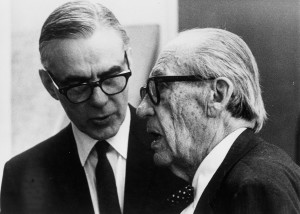
Leonard James Currie and James Adger Smyth Johnson

Leonard Currie with Walter Gropius
Leonard Currie with Walter Gropius https://50years.caus.vt.edu/history/

In the late 1950s and early 1960s, two men – Leonard James Currie, American architect, planner, educator, and James Adger Smyth Johnson, retired vice chairman and a director of Union Carbide Corporation, graduate of Virginia Tech and former member of Tech’s Board of Visitors – made indelible marks on both Virginia Tech and the town of Blacksburg. Several homes in Montgomery County still stand as monuments to their commitment to bring International Style architecture to southwest Virginia.

Leonard James Currie, who was born in 1913 and died in 1996, came to Blacksburg in 1956 to teach architecture at Virginia Tech. In 1956, Currie was appointed to replace the retiring Clinton Cowgill as department head of architecture.

He received a bachelor’s degree in architecture from the University of Minnesota in 1936 and a master’s degree in architecture from Harvard University in 1938. He did an apprenticeship with Walter Gropius and Marcel Breuer, 1938 – 1940, and was a Wheelwright traveling fellow, 1940 -1941. Gropius was head of the Bauhaus in Berlin, 1919 – 1928. Gropius and his Bauhaus protégé, Marcel Breuer, both moved to Cambridge, Massachusetts, to teach at the Harvard Graduate School of Design. Currie was a student of both and a subsequent colleague of Walter Gropius at The Architects Collaborative (TAC).

Currie joined the Carnegie Institute’s archaeological expedition to Copan, Honduras in 1941 and assisted Pan Am Airways and the U.S. Government in the construction of airport facilities in Guatemala and Nicaragua, 1941 – 1942. He served as an officer in the United States Army, 1942 – 1945, retiring as a lieutenant colonel.

He then was named assistant professor of architecture at Harvard University, 1946 – 1951. Currie provided technical assistance to the U.S. government and other institutions in Costa Rica, 1951, and served as director of the Inter-Am Housing Center in Colombia, 1951 – 1956. After he returned to the United States in 1956, he chaired the architecture department at the Virginia Polytechnic Institute.

As department head, Currie added urban design and planning to the curriculum, which became a degree program. Art courses were actively taught as support courses for the architecture degree and for the university community at large. Currie introduced international content into the curriculum and recruited new faculty with significant national and international stature.

He left Virginia Tech in 1962 to become dean of the College of Architecture and Art at the University of Illinois, Chicago, 1962 – 72. Currie continued his work as a professional architect, educator, and planner throughout the 1970s and 1980s. No longer dean, he continued to serve as a professor at the University of Illinois at Chicago, 1972 – 1981, as a Fulbright Senior Fellow, 1972 – 1973, and as a visiting professor at international universities. A partner in the firm Atkins, Currie and Payne, he later headed Leonard Currie and Associates.

Currie served as a member of the Chicago Cultural Commission, 1963 – 1966, as a co-promulgator of the Charter of Machu Picchu. He authored numerous books and articles including Housing in Costa Rica (with Rafaela Espinosa), Planning of Central American Campuses, and Designing Environments for the Aging. Involved in many different projects, Currie’s achievements include work on the Rockefeller Foundation, planning for the campus of the National University of Nicaragua, and award-winning residential homes.

He participated on various college committees and represented Virginia Tech both nationally and internationally. He endowed a scholarship in the name of his granddaughter, Michelle Currie, and funded an award for teaching excellence in the college.

Currie achieved status as a fellow of the American Institute of Architects, and in 1993, received the Virginia AIA Chapter’s highest award, the William C. Noland Medal. At CAUS awards ceremony in April, Currie was presented a special lifetime achievement award. For his achievements and outstanding service to the college, he was recently named professor emeritus of architecture.

While in Blacksburg, Currie designed a number of homes in the International Style that he learned under Gropius and Breuer. One of the homes he designed was for James Adger Smyth Johnson and his first wife, Elizabeth Jenkins Johnson, at 1620 High Knob Lane in 1962.

The house is a mid-century modern classic sitting on 66 private acres on High Knob along Cedar Run Road off of Ellett Road and adjoining the town limits of Blacksburg, Virginia. It overlooks the Ellett Valley in Montgomery County, Virginia. Nearly 64 acres of the 66 are forested.

Johnson retired as vice chairman and a director of Union Carbide Corporation. A graduate of Virginia Tech, he began his career with the National Carbide Division of Union Carbide in Cleveland, Ohio. He served as general manager of the Eveready Battery Company in Shanghai, China, during the 1930s. Following his return to the United States he held a variety of senior management positions with Union Carbide prior to be being appointed vice chairman in 1967. Johnson, who died in 1999 at the age of 91, was a former member of the Board of Visitors of Virginia Tech.